Boho Chic Ring Stacking: How to Layer Cluster and Flower Rings
Share
A loaded hand is not the look. Boho chic ring stacking is one cluster or flower ring as the lead, a slim 925 band if you want a second line, and empty fingers so the stones can be read. Colour and mixed cuts do the work. Covering every knuckle does not.
GemRings! pieces are 925 sterling silver. Gold-looking styles are 18k gold-plated over that same silver, about 3 microns thick unless a product page says otherwise. That plate is not solid gold. The cluster and flower rings below sit on the silver side: Mozambique garnet, natural opal, natural peridot. Stones are named on the listing. Do not upgrade them in your head.
What a cluster or flower ring is
A cluster is a group of stones set so they read as one shape. It is not a solitaire, and it is not a halo with one quiet rim. You see several cuts at once. Dirt sits between those cuts, so a cluster needs a cloth more often than a plain band.
A flower ring uses the same idea with petals around a centre. Tight red garnet clusters were common in nineteenth-century Bohemian jewelry. The GemRings! garnet ring is not that antique object. It is 925 silver with Mozambique natural garnets, in the same clustered layout.
Sterling is 92.5 percent silver. The rest is almost always copper, which hardens the shank so prongs can hold. Copper also means the metal can tarnish, and a tight, sweaty band can leave a faint mark on some people. That is chemistry, not a fake stamp.
How boho chic ring stacking sits on a real hand
Give the busy ring a job, then stop adding busy rings next to it. One cluster on the middle or ring finger is enough lead. A slim heart or a plain silver band can sit on the next finger, or on the same finger only if the shanks do not tilt and pinch. Leave the index or pinky empty so the hand still has a rest.
The usual miss is two clusters side by side. Two wide heads catch, spin, and hide each other. If you want more colour, move the second stone to another finger. For basic spacing that applies to any stack, see how to stack rings.
Keep metal honest. A silver cluster next to an 18k gold-plated band is fine if you already mix metals on your wrist. If your everyday hoops and chain are cool and white, stay in 925 sterling silver rings. Plated gold will scuff where two rings rub. High spots go first.
A Mozambique garnet cluster as the lead
Red is the clearest cluster colour in this catalog. The Gemological Institute of America puts most garnets between 6.5 and 7.5 on the Mohs scale, with fair to good toughness. Weekday wear is reasonable. A sharp knock on a desk edge is how a small stone loosens.
This ring is 925 sterling silver with an anti-tarnish treatment. The listing names Mozambique natural faceted garnets, a centre of about 1.5 carats, and eight stones in the cluster. Weight is about 4 grams. Sizes are EU 50, 52, and 54. Wear it alone on that finger. If you add a second ring, use a slim band on another finger, not against the garnet heads.
GIA says warm, soapy water is always safe for garnet. Steam is not recommended. Skip ultrasonic if you cannot see whether a stone is fractured. Dry the underside after you wash your hands. Soap film sits between prongs and dulls the red before the silver looks dirty.
A flower ring if you want a softer outline
If deep red feels heavy for daytime, a flower still counts as one focal piece. GIA lists opal at 5 to 6.5 on the Mohs scale, with very poor to fair toughness. It scratches. Sudden heat can open fine cracks, called crazing. Take it off to wash pans.
This ring is 925 sterling silver with an anti-tarnish treatment. The centre is a natural opal cabochon of about 1 carat. Eight more natural opal cabochons form the petals, with two cubic zirconia accents on the shoulders. Weight is about 2 grams, lighter than the garnet cluster even though the head is wide. Cubic zirconia is not a diamond. It is a bright, named stand-in.
Clean opal only with lukewarm water, a drop of mild soap, and a soft cloth. No ultrasonic, steam, or silver dip. Perfume goes on before the ring. Store it apart from harder stones so the cabochons do not get marked in a shared dish.
A peridot cluster if you want green instead of red
Green is the other easy cluster read. GIA puts peridot at 6.5 to 7 on the Mohs scale, with fair to good toughness. It will take careful everyday wear. It will not take a gym bar or a bleach sink. Acid perspiration can mark it over time, so dry the inner shank after a hot commute.
This ring is 925 sterling silver with an anti-tarnish treatment. The centre is a natural faceted peridot of about 1.7 carats, with eighteen natural peridots in mixed sizes around it. Weight is about 4 grams. Warm, soapy water is the safe clean. GIA does not recommend ultrasonic or steam on peridot.
Do not stack the peridot against the garnet. Two 4-gram heads on one finger will fight for the same skin. Pick one green or one red as the day's lead. Put a slim silver piece on the next finger if you still want a second glint.
The slim companion, not a second statement
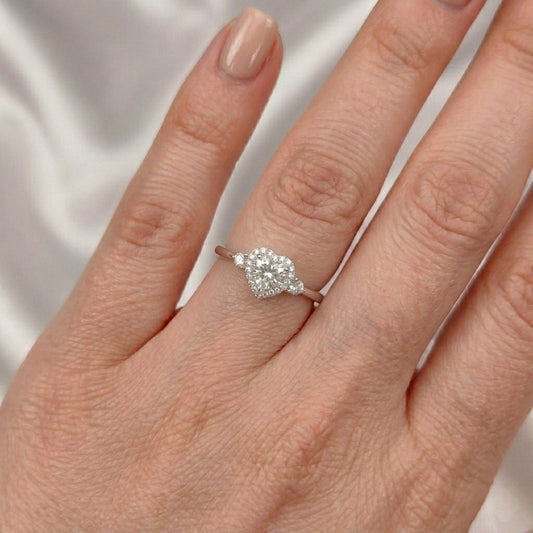
A stack needs a quiet ring. The Dainty Heart Silver Ring is 925 sterling silver, about 1.6 grams, with a 5×5 mm heart-cut cubic zirconia (about 0.8 carats) and 22 smaller CZ stones. Wear it on the finger next to the lead, or on the same finger only if both shanks lie flat and you can still bend the knuckle.
A heart next to a flower is already two motifs. If the opal flower is on, keep the companion plain or move the heart to the other hand. Mixed texture is the point. A charm shop on one digit is not.
Where the lead sits
A 4-gram cluster sits well on the middle or ring finger. Use the index for the slim heart if the middle finger already has the lead. Leave the pinky empty; a flower head on a short finger knocks cups. Skip the thumb. Cluster prongs snag pockets.
Size the stack, not just the one ring
GemRings! uses EU millimetre sizes (ISO). The three cards above are listed in 50, 52, and 54. If you sit between sizes, the ring size guide says to take the larger one. That matters more on a cluster than on a 1.6-gram heart. A tight 4-gram head holds water and rubs the inner shank in a circle.
Measure in the evening. Dominant-hand fingers are often a touch larger. A ring that already fits that finger, measured across the inner diameter, is more reliable than string. When you stack two rings on one finger, you may need the roomier listed size even if a single slim band in 52 feels perfect.
Care when several stones share a finger
Take stacks off to wash dishes, swim, and lift weights. Chlorine and bleach are hard on silver and on plated gold. After wear, wipe the inner shanks and the gallery under the stones. Store pieces dry and separate. A bathroom saucer is how opal stays damp and how garnet facets scuff a neighbour.
If you mix in an 18k gold-plated band, the plate is a surface of about 3 microns. Stacking it against a 4-gram silver cluster will wear the gold at the contact line first. That is expected. You cannot polish it back into solid gold.
Choose the lead stone first: red garnet, green peridot, or an opal flower. Then decide whether you need a slim companion at all. Many hands look finished with one cluster and two empty fingers. Read the materials line. None of these listings are solid gold, and none are diamond.
Can I wear a cluster ring every day?
Yes, if you treat the setting as a group of small stones. Garnet and peridot are hard enough for weekday wear. Take them off for the gym and for wet chores. Opal is softer; make that one a ring you remember to remove.
How many rings belong in a boho stack?
Two is enough: one cluster or flower, one slim band. Three only if the third sits on another finger. Four on one hand starts to hide the stones you bought.
Can I mix silver and gold-plated in the same stack?
Yes, if you already mix metals elsewhere. Keep the plated ring away from a heavy cluster so the 3-micron gold layer is not the surface that rubs first.
What if my cluster feels tight after a second ring?
Take the companion off that finger, or move up one listed EU size on the next order. Unused EU orders can be returned within 14 days of receipt; return postage is paid by the buyer. Do not force a 4-gram head over a swollen knuckle.