Colored Gemstone Rings on a Budget: Named Stones in 925 Silver
Share
A low price is easy. A useful ring is a named stone on a named metal. Colored gemstone rings on a budget are not mystery alloys with a photo filter. They are 925 sterling silver, an 18k gold plate about 3 microns thick when the listing is gold-looking, and a mineral you can say out loud: quartz, topaz, amethyst, or synthetic sapphire.
GemRings! pieces follow that rule. Silver styles are 925 with an anti-tarnish treatment. Gold-looking styles are the same silver core with 18k gold plate, about 3 microns, unless a product page says otherwise. That plate is not solid gold. Stones are listed as they are. Cubic zirconia is a simulant. Synthetic sapphire is laboratory-grown corundum. Do not upgrade either in your head.
What colored gemstone rings on a budget should list
Budget, here, is the gap between costume jewelry and a karat-gold diamond. You still want a shank that is sterling throughout and a stone with a species. The U.S. Federal Trade Commission’s jewelry guides treat “sterling” as 92.5 percent silver. The Gemological Institute of America says the rest is usually copper, which hardens the band so a setting can hold. Copper also means tarnish is normal. A green smear on skin is chemistry, not a fake stamp.
Read four lines before you pay:
- Metal: 925 sterling silver, or 18k gold-plated 925. “Gold tone” and “silver color” are not standards.
- Stone species: quartz, topaz, amethyst, garnet, peridot, cubic zirconia, synthetic sapphire. Color words (“pink,” “sky blue”) are not minerals.
- Treatment, if any: dyed jadeite, irradiated quartz, fracture-filled stones. If the page is silent, do not invent a treatment, and do not invent a mine.
- Weight and EU size: most GemRings! listings sit in 50, 52, and 54. A 5-gram head feels tighter than a 1.6-gram stacker in the same number.
If a shop will not write those four, the discount is the product.
The honest swaps: what you are comparing
Fine jewelry prices sit on rarity and karat gold. A budget ring keeps the color and drops the scarce material. That is a fair trade when the listing says so.
Pink “sapphire look.” Synthetic pink sapphire is laboratory-grown corundum: Mohs 9, excellent toughness, no cleavage. GIA treats it as sapphire chemically. It is not a diamond, and it is not glass. Cubic zirconia is a different material: a diamond simulant. GIA puts CZ around Mohs 8.5, notes it can yellow with age, and calls it somewhat brittle. Both are legitimate when named.
Blue “sapphire look.” Sky blue topaz is a different species: Mohs 8, with perfect basal cleavage. Hardness is not toughness. A sharp knock can split topaz. GIA says skip ultrasonic and steam; use warm, soapy water.
Green “emerald look.” Mint green quartz is quartz, Mohs 7. Peridot is its own mineral (about 6.5–7). Neither is emerald. Both can be weekday rings if you take them off for grit.
Purple that is the stone you think it is. Amethyst is purple quartz. GIA rates it Mohs 7 with good toughness. Intense light can fade some amethyst. Warm, soapy water is the safe clean. Steam is not recommended.
Household dust is mostly quartz. Stones below 7 haze faster on a ring than on a pendant. Pearl and opal are poor everyday swaps even when the price is low.
A named synthetic sapphire if you want hardness first
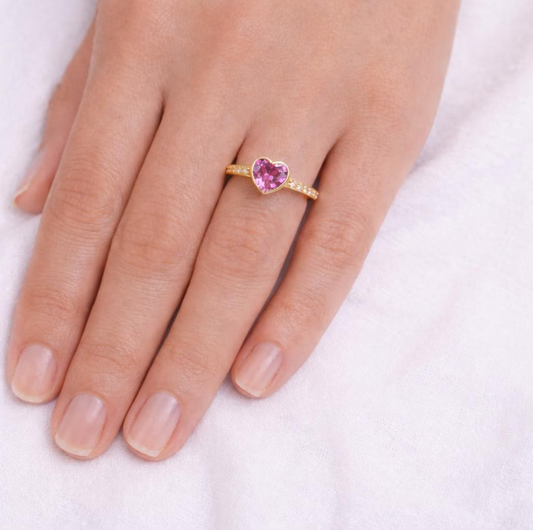
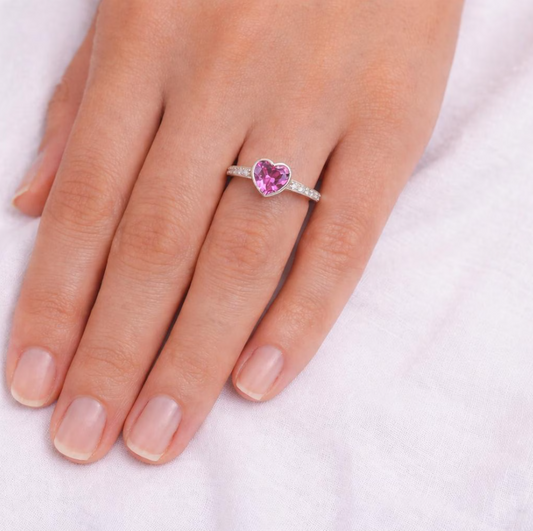
If the job is a pink heart you can type in, laboratory-grown corundum is the durable budget path. It is still a heart-cut outline, so the tip wants a prong or a bezel. It is not a mined sapphire, and the listing should say synthetic.
This ring is 925 sterling silver with an anti-tarnish treatment. The centre is a heart-cut synthetic pink sapphire of about 2 carats, with 12 cubic zirconia accents. Weight is about 4.25 grams. Sizes are EU 50, 52, and 54. The sapphire is the weekday stone. The CZ melee is the sparkle that also holds lotion; dry the gallery after you wash your hands. Wear it alone on that finger if you want the heart to read. Browse other cool-metal styles in 925 sterling silver rings.
Natural amethyst if you want a real purple, not a dye
Amethyst is one of the few fine-jewelry colors that still arrives at a silver price in a 3-carat centre. You are buying quartz, not a rare corundum. That is the point of the budget. A halo adds more small stones, which means more grit between prongs and a heavier shank.
This ring is 925 sterling silver with an anti-tarnish treatment. The centre is a natural emerald-cut amethyst of about 3.2 carats, with 20 smaller natural amethysts in the halo. Weight is about 5.4 grams, heavy enough that a tight EU 50 will rub. If you sit between sizes, the ring size guide says to take the larger one. Leave the next finger empty so the halo does not knock a neighbour.
Sky blue topaz if you want blue without sapphire money
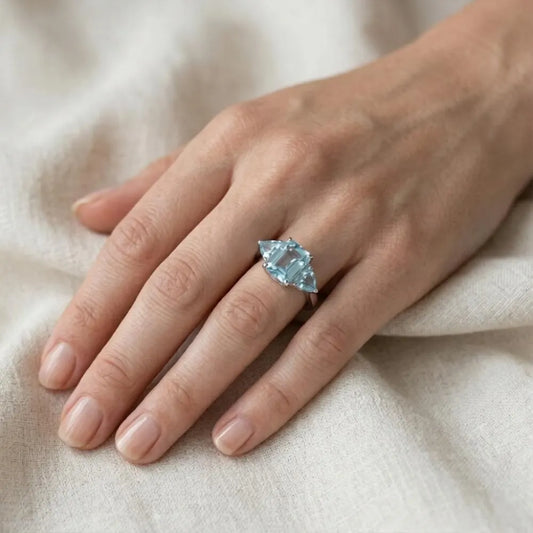
Topaz is the catalog’s honest blue. It is not sapphire. It is harder than quartz and more fragile than the Mohs number suggests. Treat it like a weekday ring you remember to take off for the gym and for a bleach sink. Do not put it in an ultrasonic or under steam.
This ring is 925 sterling silver with an anti-tarnish treatment. The centre is a natural oval sky blue topaz of about 3 carats, framed by 20 light Swiss blue topaz stones. Weight is about 3.3 grams. That is lighter than the amethyst halo and still a raised head. Check knuckle clearance. A slim silver band on another finger is enough if you still want a second glint.
Silver or 18k gold plate is color, not a higher stone
Switching to gold color does not upgrade quartz to citrine or CZ to diamond. GemRings! gold styles are 18k gold (75 percent gold in the plate alloy) about 3 microns thick on a 925 core. The U.S. FTC’s jewelry guides treat “gold plated” and “gold electroplate” as a surface. Their “heavy gold electroplate” example is 2.5 microns of fine gold. A 3-micron 18k layer is a real wearing surface. It is still a surface. Keys, desks, and stacked rings hit the high spots first. When the plate thins, you should see silver, not brass.
Stay in silver if your everyday chain and hoops are cool. Use 18k gold-plated rings if your other jewelry is already warm. Mixing metals is fine if you already do it on your wrist. Plated gold next to a heavy silver halo will scuff at the contact line. That is expected wear, not a defect you polish back into solid gold. A cloth will not put the gold back.
What a budget ring will not do
It will not hold a resale story. It will not survive chlorine, bleach, or a barbell. Sterling tarnishes. Plate rubs. Quartz and amethyst take a haze from grit. Topaz can chip on an edge. Cubic zirconia can yellow. Buy the materials as they are.
Each ring ships in a gift-ready box. EU orders include free shipping. Unused pieces can come back within 14 days of receipt; the buyer pays return postage. Sales outside the EU are final, so size carefully if you are sending farther.
A short buying sequence
Pick the color you already wear, not a stone you saw once in a film still. Then pick the species that matches how you use your hands. Synthetic sapphire if you type and commute. Amethyst if you want a natural purple and will dry the halo. Topaz if you want blue and will take the ring off for impact. Quartz if you want a large face of color and accept Mohs 7.
Measure in the evening. Dominant-hand fingers are often a touch larger. A borrowed ring from that finger, measured across the inner diameter, beats string. Between two listed sizes, take the larger, especially on a 5-gram halo. Then stop adding “just one more” stone to the same finger. One named centre is the budget working.
Are colored gemstone rings on a budget “real” jewelry?
Yes, if the metal is 925 and the stone is named. Real means the specification. It does not mean a mined diamond or solid 18k gold. Those are different products.
Is synthetic sapphire a fake?
No. It is laboratory-grown corundum, the same mineral as sapphire. The honest word is synthetic or lab-grown. Glass and dyed quartz are the fakes when a shop calls them sapphire.
Will a gold-plated gemstone ring last?
The silver core lasts. The 3-micron 18k plate is the wearing budget. Keep it off chlorine and stacked against a heavy head. You cannot restore plate with a cloth.
Which stone is the safest everyday budget pick?
Synthetic sapphire (Mohs 9) for hardness. Amethyst (Mohs 7, good toughness) for a natural color you will actually wear. Topaz only if you accept cleavage and skip the gym with it on.