Heart-Shaped Gemstone Rings: Romantic Symbolism Meets Everyday Elegance
Share
A heart on a ring is easy to read from across a table. That is the point. Heart-shaped gemstone rings are not a Valentine costume. They are a cut: two lobes, a cleft, and a tip that needs a setting that actually protects it. If the listing names the stone and the metal, the romance can survive a weekday.
GemRings! rings are 925 sterling silver. Gold styles add an 18k gold plate about 3 microns thick over that silver core, unless a product page says otherwise. None of the hearts in this catalog is a mined diamond. When a page says synthetic pink sapphire, that is laboratory-grown corundum. Cubic zirconia is a diamond simulant. Quartz is quartz.
What a heart-cut stone actually is
The Gemological Institute of America treats a heart as a fancy outline with named parts. The cleft is the V between the two rounded lobes. Below that, the stone widens at the belly, tapers through the wings, and ends at a point. A well-cut heart has matching lobes, a cleft you can see, and a point that is not a needle. GIA examples of pleasing hearts often sit around a 1:1 to 1:1.1 length-to-width ratio. Stretch it and you get a distorted pear.
The outline is older than product photography. The International Gem Society notes a 1463 letter from Galeazzo Maria Sforza that already treats a “heart-shaped diamond” as a known luxury. In 1562 Mary, Queen of Scots, sent Elizabeth I a heart-shaped diamond ring—usually cited as courtesy and political friendship, not a love token. A metal heart motif soldered onto a band is a different product from a heart-cut gem. The rings in this guide are stones cut as hearts, set in 925 sterling silver or 18k gold-plated silver.
What the shape has meant (and what it has not)
Medieval Europe used the heart outline as a love glyph. Victorians wore it in lockets, charms, and rings until it became the default romantic shorthand. The custom of putting a ring on the fourth finger comes from a Roman belief in a vein running to the heart (vena amoris). Anatomy does not give that finger a unique vein. The habit stuck anyway.
Today the same outline can mean partnership, a promise, a friendship, or a ring you bought because the cut looked right. It is a graphic, not a contract, and no gemstone treats anything. Pink (rose quartz, pink sapphire, pink cubic zirconia) reads as affection because culture trained you that way. Yellow lemon quartz keeps the heart and drops the greeting-card palette. Mint green quartz is useful if you want the shape without the cliché.
Read the species on the page. “Pink” is a color. Cubic zirconia is a simulant. Synthetic sapphire is lab-grown corundum. Rose quartz and lemon quartz are quartz. If a shop will not name the mineral, do not buy the romance.
Which stones survive a weekday—and a pointed outline
GIA defines durability as hardness plus toughness plus stability, not Mohs alone, and Mohs is not a linear scale. Household dust is mostly quartz. Gems below 7 haze faster on a ring than on a pendant.
- Quartz (rose, lemon, mint green): Mohs 7. Fine for daily rings if you do not use the stone as a tool. Quartz has no cleavage like topaz. The heart point still chips if the girdle is knife-thin and unprotected.
- Cubic zirconia: GIA lists CZ at about Mohs 8.5. Hard, usually eye-clean, still a simulant. GIA notes it can yellow with age and can be somewhat brittle.
- Synthetic sapphire: corundum, Mohs 9, excellent toughness, no cleavage—the same mineral family as natural sapphire. Synthetic means laboratory-grown, not glass.
The weak spot of a heart is geometry. GIA warns against a knife-edge girdle and an unprotected tip. A prong on the point, or a bezel that covers it, is the difference between a ring you forget you are wearing and a ring that snags knitwear. A 12 mm heart on a 3-gram band is not the same object as a 5 mm heart on a 1.6-gram stacker.
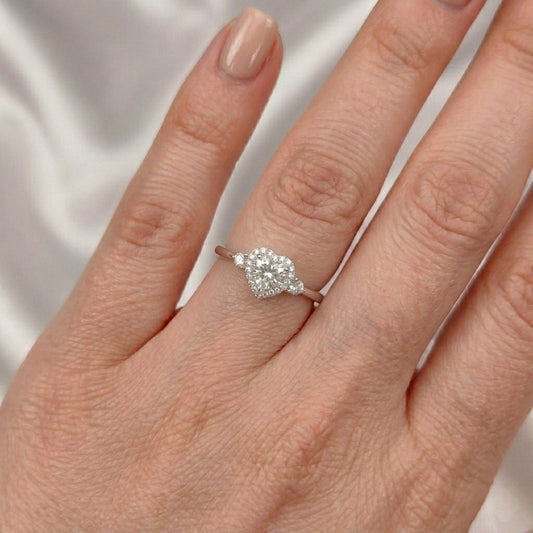
This is the small everyday version: 925 sterling silver with an anti-tarnish treatment, a 5×5 mm heart-cut cubic zirconia of about 0.8 carats, 22 smaller cubic zirconia, about 1.6 grams. Cubic zirconia is a diamond simulant. At this scale the outline reads as a heart without occupying the whole knuckle, which is why it stacks. More cool-metal hearts live in 925 sterling silver rings.
How to choose heart-shaped gemstone rings you will actually wear
Use the spec sheet, not the nickname.
- Confirm it is a heart-cut stone. A heart-cut gem is one outline. A round stone above a metal heart is a motif. A wishbone shank with a micro-heart is a different search.
- Name the mineral. Quartz, synthetic sapphire, and cubic zirconia are all legitimate when the page says so. They are not interchangeable on hardness or aging.
- Look at the point. A needle tip sitting above the shank with no prong or bezel is a snag risk, not a flourish.
- Match size to the week you live. A 5 mm heart can ride a keyboard. A 10–12 mm heart is a focal piece. You can wear a large heart every day if the head is not a tower and you take it off for gym, pool, and grit.
- Size the shank you are buying. GemRings! lists EU 50, 52, and 54. A 4-gram ring with a tall heart can feel tighter than a 1.6-gram stacker in the same number. Measure in the evening; between sizes, go up. Use the ring size guide instead of copying a thin band’s size onto a domed one.
This is a true one-stone heart in gold color: 18k gold-plated 925 sterling silver, a 10×10 mm heart-cut lemon quartz of about 3 carats, a slightly domed band, about 3.1 grams. The page states the 3-micron 18k plate. Lemon quartz is quartz—Mohs 7—not yellow sapphire and not citrine unless a lab report says so. No halo, no listed side stones. Warm-metal versions live in 18k gold-plated rings.
Silver or 18k gold plate is color, not a new cut
Silver reads as a cool spotlight. The same heart-cut layout in 18k gold plate reads warmer, closer to the engagement silhouette people already know. GemRings! gold plate is about 3 microns of 18k gold (75% gold) on a 925 core—a wearing surface, not solid gold. While intact you see gold. If it wears at the inner shank you see silver, not brass. Keep either metal out of pools and abrasive cleaners. Do not use toothpaste, baking soda, or silver dip on an 18k gold-plated shank; those can strip the plate.
A larger rose quartz heart in the same gold-plated construction (12×12 mm, about 3 carats, floral engraving on the band, about 3 grams) is a statement, not a stacker. Quartz at Mohs 7 still wants a protected point and empty space on the finger.
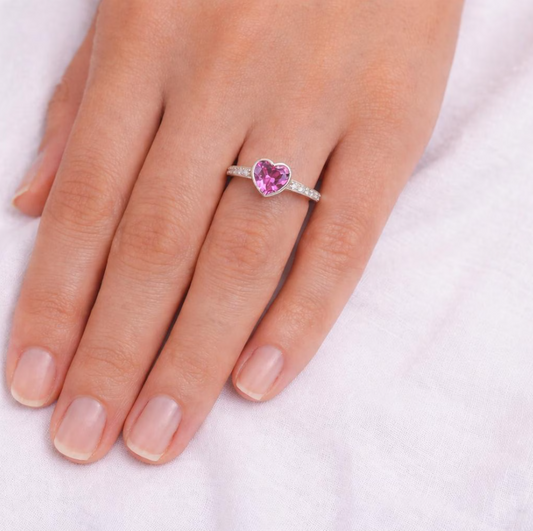
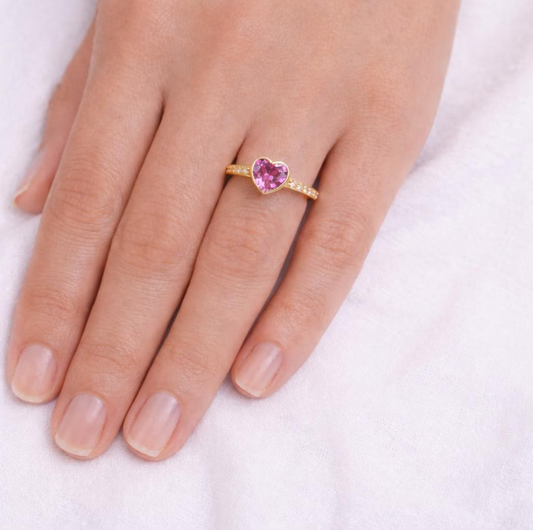
The romantic brief, stated honestly: 925 sterling silver with an anti-tarnish treatment, a heart-shaped synthetic pink sapphire of about 2 carats, 12 cubic zirconia around it, about 4.25 grams. Synthetic sapphire is corundum (Mohs 9), not glass. The extra melee adds sparkle and more places for lotion to sit; dry the ring. There is a gold-plated twin with the same synthetic pink sapphire if you want warmth instead of cool metal. Neither listing is a natural pink sapphire from a mine.
Styling without turning your hand into a slogan
A small heart next to a plain band looks deliberate. A large heart next to another large heart looks busy. Leave a gap beside a 10 mm outline so the cleft stays readable. Mix metals if you want: a silver heart beside a gold-plated band is a color choice, not a rule break. Take heart-cut rings off for weights, detergent, and chlorine. Store them apart so a harder stone does not frost a softer one. If a tip prong opens or the stone rocks, stop wearing it and see a jeweler.
Heart-shaped gemstone rings earn their keep when the cut is a real heart, the mineral is named, and the point is set like jewelry you will actually use. Buy the spec sheet. Let the symbolism be extra, not the entire product.
FAQ
Are heart-shaped gemstone rings only for Valentine’s Day?
No. The cut is a year-round outline. Pink stones read more seasonal because of culture. Lemon quartz or a small cubic zirconia heart looks less like a holiday card.
Do GemRings! heart rings use diamonds?
No. Listings name cubic zirconia, quartz, or synthetic sapphire, set in 925 sterling silver or 18k gold-plated 925 sterling silver.
Is a heart cut too fragile for everyday wear?
The outline is more snag-prone than a round or cushion, especially at the tip. Quartz (Mohs 7), cubic zirconia (about 8.5), and synthetic sapphire (Mohs 9) can all do weekdays if the point is protected and you remove the ring for rough work.
What does a heart ring symbolize?
Conventionally affection, partnership, or self-purchase. Historically it has also marked friendship. The wearer decides. The stone does not.