How to Measure Ring Size at Home: An Accurate International Chart
Share
A ring that looks right in a product photo can still spin, pinch, or stop at the knuckle. Guessing from a US screenshot or a cold morning measurement is how that happens. If you need to know how to measure ring size at home before you order, you only need a strip of paper, a millimetre ruler, and one conversion chart you actually stick to.
GemRings! sells in European ISO sizes. The number on the variant—usually 50, 52, or 54—is the inner circumference of the hoop in millimetres, not a US number and not a UK letter. The brand’s rings are 925 sterling silver; gold styles add an 18k gold plate about 3 microns thick over that silver core unless a product page says otherwise. The metal does not change the size system.
What an EU ring size actually measures
The jewellery standard ISO 8653 treats ring-size as the inner circumference of the hoop, in millimetres. A size 52 ring is a 52 mm loop on the inside. Diameter is that circumference divided by π—about 16.6 mm for a 52. That is why a paper wrap around the finger and a calliper reading across an old ring can land on the same number if you do both cleanly.
GemRings! publishes both columns on its ring size guide. Use that page as the store chart. Other websites disagree by a quarter size; hopping between charts is how a careful measurement still arrives tight. Most listings offer 50, 52, and 54. If your tape says 51 or 53, choose among those three. Between two options, take the larger—especially on a wide or domed band.
How to measure ring size at home with a paper strip
This is the method on the size guide, written out so the paper does not stretch and the hand is not cold.
- Cut a strip of paper about 4–6 mm wide. Skip yarn, elastic, or gift ribbon—those compress and read small.
- Wrap it around the base of the intended finger, where the ring will sit, not halfway up the pad.
- Pull it snug so it cannot spin, but not so tight that the skin bulges. Mark the overlap.
- Lay the strip flat and measure the marked length in millimetres. That number is the EU size.
- Slide the marked loop over the knuckle. If it will not pass, measure the knuckle the same way and use the larger reading.
- Repeat once the same evening. If the two readings differ by more than a millimetre, take a third and use the middle value, then round to the nearest GemRings! size.
Measure in the evening, at room temperature, when fingers are slightly larger. Cold hands shrink; a ring sized after a winter walk will feel tight by dinner. Skip the tape right after a hot shower, a workout, or a very salty meal—those readings run high for a few hours. That is a fit issue, not a medical claim.
Measure the finger you will actually wear. The same digit on the other hand is often a different size. Write the finger next to the number so a gift order does not land on the wrong hand.
Measure a ring you already own
If a comfortable ring already lives on that finger, you can skip the paper. The Gemological Institute of America notes that converting from an existing hoop only works when the inside is perfectly round. Bent or ovalized bands lie.
- Place the ring on a ruler or digital calliper.
- Measure the inside diameter straight across the centre, inner edge to inner edge, in millimetres. Do not include the metal thickness.
- Match that diameter to the chart below. A 15.9 mm inside diameter is EU 50; 16.6 mm is EU 52; 17.2 mm is EU 54.
If the old ring is a thin stacking hoop and the new one is a dome, do not copy the stamp blindly. Size up one GemRings! step if you sit between 50 and 52, or 52 and 54.
Why the same finger changes size
Heat opens blood vessels near the skin; cold does the opposite. After a day of standing and using your hands, many people are a little fuller in the evening than at breakfast. That swing is often about half a conventional size—enough to turn a “perfect” morning measurement into a ring you fight off at night.
Humidity, long flights, and high-sodium days can add temporary fullness. Measure more than once on ordinary days. If you are between sizes, choose the larger: a slightly loose slim band can be stacked, but a tight wide band will not pass a swollen knuckle.
Slim bands, wide bands, and the same EU number
Width changes how a size feels. More metal presses on more skin, so a bold shank in size 52 can feel like a slim 52 that shrank. When you move from a 2 mm band to a wide or domed shank, plan to go up about half a size—on this catalog, the next listed size. Our guide to how to choose ring width for your hand shape covers proportion; this section is only about the hoop that has to slide on.
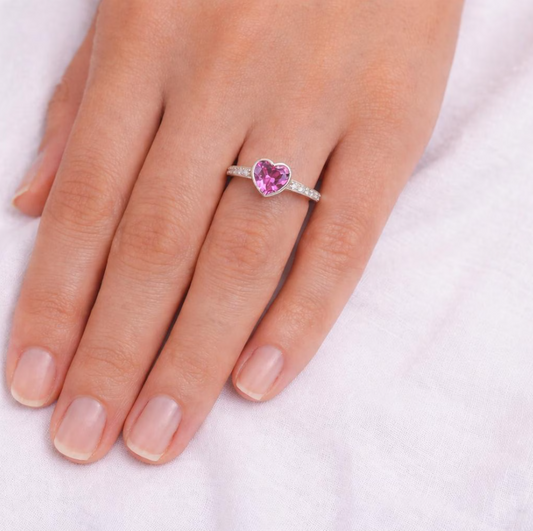
This is the catalog’s slim example: 925 sterling silver with an anti-tarnish treatment, a heart-cut cubic zirconia of about 5×5 mm (roughly 0.8 carats), 22 smaller cubic zirconia accents, and a weight of about 1.6 grams. Cubic zirconia is a diamond simulant, not a diamond. In size 52 it will feel closer to the paper measurement than a wide band will. If your evening wrap is 51 mm, this profile can sometimes stay on a 50—if the knuckle agrees.
This is the catalog’s wide example: 18k gold-plated 925 sterling silver. The product page states a 3-micron 18k plate. The centre is an oval-cut rock crystal of about 2.4 carats—colorless quartz, not glass and not diamond. The shank is a bold, smooth dome; the piece weighs about 3 grams. Gram weight is close to several slimmer rings in the same shop. Coverage is not. If your paper wrap is 51–52 mm, order 52 only if the knuckle is easy; otherwise take 54. A dome that stops halfway down the finger is not “breaking in.”
A halo does not widen the shank as much as a dome, but it raises the head. This ring is 925 sterling silver with an anti-tarnish treatment. The centre is a natural oval sky-blue topaz of about 3 carats, framed by 20 smaller light Swiss blue topaz stones; it weighs about 3.3 grams. Check knuckle clearance and whether the setting knocks the next finger. If two halo heads will sit side by side, give each its own digit.
International ring size chart (EU, US, UK)
GemRings! sizes are the EU column. Circumference is the same number in millimetres. Diameter is the inside measurement if you are converting an existing ring. US and UK values are the store’s own conversions—use them here, not a third chart that disagrees by a quarter size.
| EU | Diameter (mm) | Circumference (mm) | US | UK |
|---|---|---|---|---|
| 48 | 15.3 | 48.0 | 4.5 | I½ |
| 49 | 15.6 | 49.0 | 5 | J½ |
| 50 | 15.9 | 50.0 | 5.25 | K |
| 51 | 16.2 | 51.0 | 5.75 | L |
| 52 | 16.6 | 52.0 | 6 | L½ |
| 53 | 16.9 | 53.0 | 6.5 | M½ |
| 54 | 17.2 | 54.0 | 6.75 | N½ |
If you are between rows, choose the larger size for comfort. Still unsure after two evening measurements? Message support from the size guide, then browse all rings in the size you trust.
Sizing mistakes that waste a checkout
- Stretchy string. It bites into the finger and under-reads. Paper or a non-stretch tailor’s tape only.
- Measuring only the base. The knuckle is the gate. If the paper loop cannot pass it, the ring cannot either.
- One cold-morning reading. Size for the larger end of a normal day.
- Copying a US number from another brand. Convert through the GemRings! chart. “US 6” is EU 52 here.
- Ignoring width. A 1.6-gram stacking heart and a domed 3-gram gold-plated band do not wear like the same 52.
- Measuring the wrong finger. Index and ring fingers are not interchangeable. Neither are left and right.
Frequently asked questions
What if I am between EU 50 and 52?
Order 52 for everyday comfort, and almost always 52 or 54—not 50—if the ring is a bold dome or a heavy halo. A slim stacking band is the only profile that sometimes tolerates the smaller size, and only if the knuckle is easy.
Can I buy a gift without measuring?
Borrow a ring she already wears on that finger and measure the inside diameter. If you cannot, a discreet paper wrap or a photo of a ring on a ruler beats guessing. GemRings! packing is gift-ready; the size still has to be hers.
Do gold-plated and silver rings fit the same?
Yes. Gold styles in this catalog are 18k gold-plated 925 sterling silver, with a plate about 3 microns thick. You are sizing the silver hoop. Plating wear does not change the inner circumference.
Is a printable ring-size app accurate?
Only if the page is scaled to 100% and you check the on-screen ruler against a real one. A paper strip and a school ruler beat an uncalibrated screenshot.
Measure twice in the evening, write the EU number next to the finger, and order the listed size that matches. The chart does not care about trends. Your knuckle does.