How to Mix Chunky and Dainty Rings Without Crowding Your Hand
Share
A wide dome and a slim heart do not cancel each other. They need different jobs. If you want to know how to mix chunky and dainty rings, treat the large piece as the sentence and the thin ones as commas.
GemRings! rings are 925 sterling silver. Gold styles add an 18k gold plate about 3 microns thick over that silver core, unless a product page says otherwise. Stones are named on the listing. None of this is solid karat gold. None of it is a mined diamond.
What “chunky” and “dainty” mean on a real finger
In this catalog, chunky is not a costume cuff. It is a taller band, a large head, or a cluster that covers more of the finger. The bold dome with oval rock crystal is about 3 grams with a wide shank. The mint green quartz silver ring is about 5.2 grams with a cushion of about 9.7 carats. Those sit high. They catch knit cuffs.
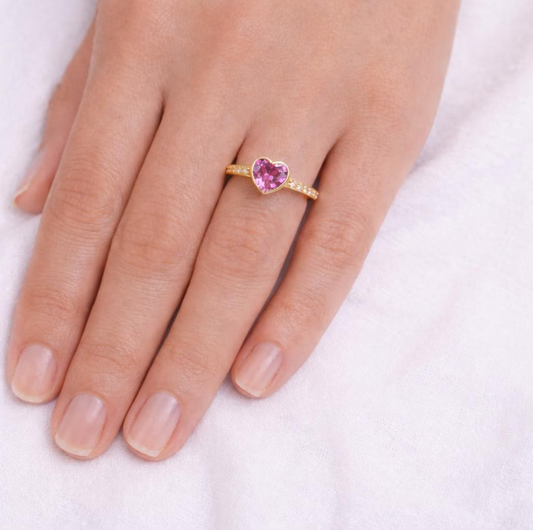
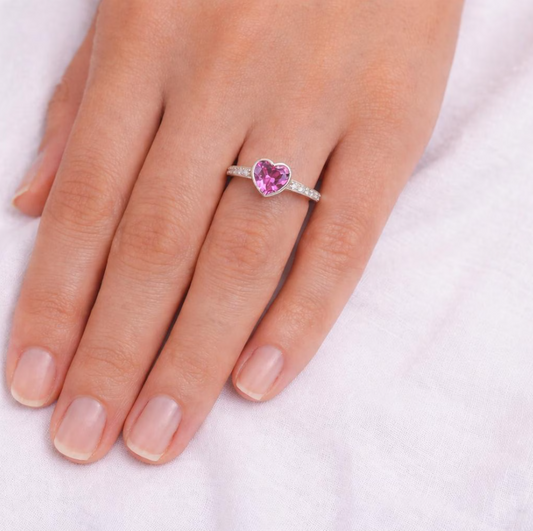
Dainty is a low heart or a slim trilogy that leaves skin visible on both sides. The dainty heart silver ring is about 1.6 grams with a 5×5 mm cubic zirconia. You can wear two of those and still see knuckle. Weight is a clue, not a verdict. A 4-gram cluster can feel heavier than a 3-gram dome because the head is wider. Make a fist. If the setting hits the next finger before the hand closes, treat it as a statement piece.
How to mix chunky and dainty rings on one hand
Stacking guides from jewelers who do this daily keep repeating one proportion: one hero, then two or three slimmer companions. Catbird starts with a ring you already wear and then changes scale. BlueStone’s rule of thumb is similar: for every wide or statement ring, add two or three thin bands. What fails is two wide heads pressed together. They grind. They read as one lump.
A weekday formula that works with GemRings! pieces:
- Pick the ring with the most height or the most texture. That is the hero.
- Add one slim silver or gold-plated piece beside it, or on the next finger.
- Leave at least one finger empty on that hand.
- Stop when you can type without settings knocking.
You do not need a matching set. Contrast is the point of chunky vs dainty rings stacking: a polished dome next to a tiny heart, or a cluster next to a thin band of bare skin. For general layering (not just scale), see how to stack rings.
This is the hero case. 18k gold-plated 925 sterling silver, an oval rock crystal of about 2.4 carats, a bold band, about 3 grams. The product page states the 3-micron 18k plate. Rock crystal is quartz (Mohs 7). It will take weekday wear if you do not use the stone as a tool. Do not park a cubic zirconia cluster against that oval overnight; cubic zirconia sits around Mohs 8.5 and will haze quartz. More warm-metal versions live in 18k gold-plated rings.
Put the heavy ring where it can lead
You do not have to stack everything on the fourth finger. A dome or a large heart often reads cleaner on the index or middle finger, with a slim piece on the ring finger of the same hand. Skip a finger between two statement heads. Two clusters on adjacent fingers look busy. If your fingers are short, a second thick shank can visually cut them. Prefer a tall, narrow head (marquise, oval set along the finger) over another wide band.
925 sterling silver with an anti-tarnish treatment, a heart-cut cubic zirconia of 5×5 mm (about 0.8 carats), 22 smaller cubic zirconia, about 1.6 grams. This is a companion, not a second speech. Wear it next to a dome, or alone on the other hand if the first stack is already loud.
Texture is the third variable
Width is not the only contrast. A smooth dome next to another smooth band can still look flat. A cluster, a halo, or a godronné (fluted) shank adds a different surface. A cluster is mid-weight: more head than a slim heart, less shank than a dome. Treat it as the hero if you are not wearing the dome that day. Do not put a cluster and a large heart on the same finger. The heads will tilt and scratch.
925 sterling silver with an anti-tarnish treatment, Mozambique garnets of about 1.5 carats in the center group plus eight more faceted garnets, about 4 grams. Garnet is typically about Mohs 6.5 to 7.5. It can sit beside silver hearts. It should not sleep under a cubic zirconia halo. The head is wide enough that a second ring on the same finger needs a low profile.
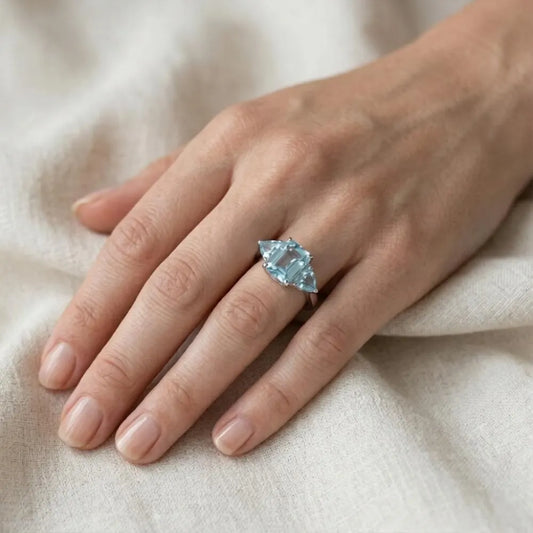
Godronné gold-plated rings (sky blue topaz or pink quartz) are a middle path: oval stone, fluted metal, about 2.4 to 3 carats. They are chunky in texture, not in cuff width. Pair one with a slim silver heart, not with the bold dome.
Metals can mix. Plate still wears.
Silver next to 18k gold-plated silver is a normal stack. Repeat each metal once if you want the mix to look chosen. A gold dome plus a gold-plated marquise plus one silver heart is easier to read than five mixed metals with no repeat.
The plate is a wearing surface about 3 microns thick, not solid gold. Rings that rub all day thin that color at the inner shank and on high ridges. A tight same-finger stack of a fluted band against a cluster is how you see silver through gold first. Give plated pieces a little air. Do not polish them with a silver cloth as if they were bare sterling.
Softer stones do not belong in a tight grind
The Gemological Institute of America treats hardness as scratch resistance, not a full durability score. Household dust is mostly quartz. Gems below Mohs 7 haze faster on a ring than on a pendant.
- Cubic zirconia: about Mohs 8.5. Fine as slim sparkle. Hard enough to mark quartz and pearl.
- Quartz family (rock crystal, rose, lemon, amethyst): Mohs 7. Daily rings if you skip the gym and the sink pile. Garnet sits near the same range.
- Topaz: Mohs 8, with cleavage. A tight stack makes knocks more likely.
- Pearl and opal: pearl about Mohs 2.5; opal 5 to 6.5 and it can dry. Last on after perfume. Not the middle of a three-ring sandwich.
If you like a pearl or an opal flower on the same hand as a chunky ring, put them on different fingers. Hard against soft is sandpaper, even when both rings look dainty.
Fit still decides whether the stack stays put
A stack that spins is a size problem, not a styling one. Two rings on one finger need a slightly closer fit than one ring. Measure at the end of the day. Use the EU chart on the ring size guide. Everyday sizes here run around 48 to 54. If a dome stops at the knuckle and a slim heart slides over easily, they can still be different sizes. Do not size the heart up to match the dome or it will orbit. Take the stack off to wash hands if soap film makes rings twist. Dry the metal. Put the hero back first.
A weekday stack you can type in
Two metals, two scales. Index: bold dome, gold-plated rock crystal. Ring finger: dainty heart, silver. Middle and pinky empty.
All silver, different heads. Middle finger: garnet cluster. Ring finger: dainty heart. Index empty.
One ring. A godronné gold-plated oval on the ring finger and nothing else that day. A chunky ring does not require company.
Build the combination over weeks, not in one checkout. The pieces you already wear to work are the test. If a pair clicks on the keyboard or catches a cuff, drop the extra band. Comfort is part of the look.
FAQ
Can you wear a chunky ring and a dainty ring on the same finger?
Yes, if the chunky ring has a low neighboring edge and the dainty ring is slim enough to sit without tilting. A tall cluster plus a large heart on one finger is usually too much head. Move one of them.
How many rings is too many?
On one hand, three is plenty when one of them is chunky. Two statement heads plus two slim bands is how the hand starts to look crowded. Empty fingers are part of the design.
Is gold-plated jewelry too soft to stack?
The 925 core is as strong as the silver rings. The 18k plate is thin. Stacking is fine if the rings are not grinding all day. Same-finger stacks of two textured gold-plated bands wear the plate faster.
Do cubic zirconia hearts count as dainty if they sparkle?
Scale is the band and the stone size, not the glitter. A 5×5 mm heart on a light shank is dainty. A 12×12 mm rose quartz heart is not, even in a similar outline.