How to Store Rings to Prevent Scratches and Tarnish
Share
A ring spends more hours off your hand than on it. Most damage is not a dramatic knock. It is a ceramic dish by the sink: silver going dull, an 18k gold plate rubbing thin, a pearl taking a scratch from a harder stone. If you want to know how to store rings to prevent tarnish and keep settings from grinding each other, treat the box as part of the jewelry.
GemRings! rings are 925 sterling silver. Gold styles add an 18k gold plate about 3 microns thick over that silver core, unless a product page says otherwise. Stones are named on the listing. None of this is solid karat gold. None of it is a mined diamond.
The catch-all dish is the problem
A bowl next to the tap looks organized. It is a humidifier with a view of the faucet. Water, soap film, and toothpaste residue sit on shanks. Rings knock into each other every time you drop another one in.
The Gemological Institute of America recommends compartmentalized, fabric-lined storage so finishes and gemstones do not scratch. Velvet is padding, not a force field. The rule is one ring per slot or pouch. A stack you wear together still needs to come apart at night.
Harder stones frost softer ones. GIA’s Mohs scale is relative, not linear, but the order still matters. Cubic zirconia sits around Mohs 8.5. Quartz—amethyst, lemon quartz, champagne quartz, citrine—is 7. Opal is 5 to 6.5. Pearl is about 2.5. Household dust is mostly quartz. A cubic zirconia halo stored against a pearl is sandpaper in slow motion.
How to store rings to prevent tarnish on sterling silver
Tarnish is not dirt you failed to wash off. The Canadian Conservation Institute describes it as a surface reaction: silver meets sulfur-containing gases in air—especially hydrogen sulfide—and forms silver sulfide (Ag2S). On sterling (92.5% silver, 7.5% copper), copper sulfide joins the film. The metal looks yellow, then brown, then grey-black.
Humidity speeds the same reaction. CCI recommends dry storage, generally below 50% relative humidity. A bathroom cabinet fails that test. So does a windowsill above a kettle, or a gym bag that never fully dries.
What actually helps:
- Wipe the ring with a soft, dry cloth after wear so lotion and salt are not sealed onto the metal.
- Give it its own pouch or compartment. Metal-on-metal abrasion exposes fresh silver, which tarnishes faster.
- Limit air. A zip bag with the extra air pressed out, or a closed box with a commercial anti-tarnish strip, cuts sulfur exposure. Replace strips on the maker’s schedule, often every few months.
- Keep silver away from rubber bands, latex, wool, and newspaper. Those materials can off-gas sulfur.
- Silica gel can dry a closed box of metal-only pieces. Do not drop a desiccant pack onto a pearl or opal.
Some GemRings! silver listings mention an anti-tarnish treatment. That is a factory finish, not a license to leave the ring in steam. If tarnish already shows, clean it with a method that matches the stones—see how to clean silver jewelry at home. Do not use toothpaste, baking soda paste, or chemical silver dip on rings with gems or gold plate.
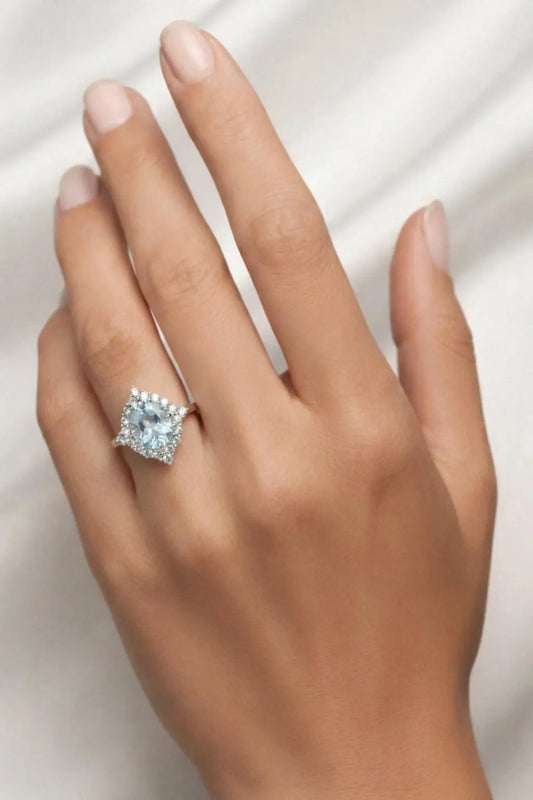
This is a weekday silver ring with two weak points in a junk dish: a marquise outline, and an unprotected pile. 925 sterling silver, a natural champagne quartz of about 1 carat, about 3 grams, no side-stone line. Quartz at Mohs 7 will lose polish if a harder stone rides it all night. More cool-metal pieces live in 925 sterling silver rings.
Gold plate is a wearing surface. Storage can sand it off
An 18k gold plate about 3 microns thick is color and a thin armor over the 925 core—not solid gold. While it is intact you see gold. Abrasion from another ring, a zipper, or a key bowl is how you see silver at the inner shank first. Wear (chlorine, gym chalk, keys) is a different problem from storage; the box’s job is to stop other jewelry from sanding the plate overnight.
Store gold-plated rings the way you store silver you do not want scratched: separate, dry, lined. Do not toss them in with cubic zirconia clusters. Do not polish them with a silver cloth as if they were bare sterling—the cloth is mildly abrasive and can thin the plate. Do not use silver dip. Keep them out of chlorine; a pouch will not undo a swim.
A closed pouch is enough. You do not need a vacuum. You do need to stop the ring from skating across a harder neighbor.
18k gold-plated 925 sterling silver, a 10×10 mm heart-cut lemon quartz of about 3 carats, slightly domed band, about 3.1 grams. The page states the 3-micron 18k plate. The heart point and the plate both lose if this sits under a cluster ring. Warm-metal versions live in 18k gold-plated rings.
Pearls and opals do not want a desert
GIA ranks pearl at Mohs 2.5. Heat can dehydrate nacre and crack it. Hair spray, perfume, cosmetics, and perspiration attack the surface. Wipe a pearl ring with a very soft cloth after wear. Store it in a soft, breathable pouch—not a sealed plastic bag for months, and not under a quartz or cubic zirconia ring.
GIA notes that opal is hydrated silica and can contain up to 20% water. Hardness is 5 to 6.5. Crazing—a network of surface cracks—is the risk if the stone dries hard. GIA’s own FAQ is cautious: some people store opals in water; there is no strong evidence it prevents drying, though it is unlikely to hurt a solid opal and may help in a very dry climate. Jewelers sometimes put a glass of water in an opal case so display lights do not parch the air. For a home drawer, skip the water bath. Use a padded slot away from heat vents, windowsills, and silica gel packs. Do not park an opal against a harder gem.
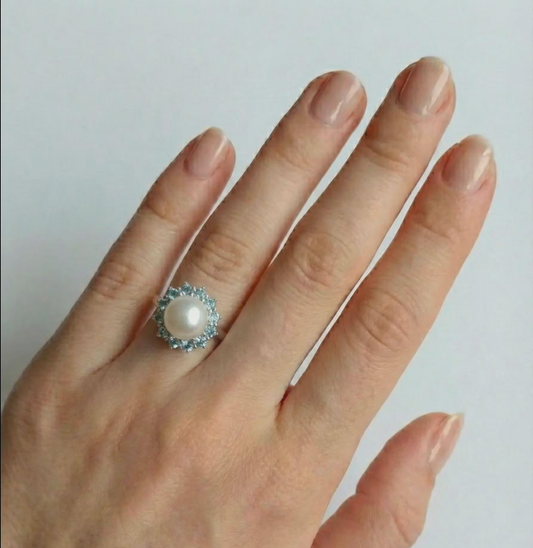
925 sterling silver with an anti-tarnish treatment, a freshwater button pearl of about 4.7 carats, 24 light Swiss blue topaz, about 4.5 grams. The pearl is the storage problem. Topaz is harder (Mohs 8) and can mark nacre if another ring stacks on this head in a dish. Last on after perfume dries. First into its own pouch.
A setup you will actually use
Two zones beat one pretty box you never open.
Landing tray (day). A small lined dish or a ring cone only for the pair you took off to wash your hands—empty it every night. Not next to the shower. Not on the kitchen sink.
Overnight box. A compartment case or a row of labeled pouches. Everyday silver in anti-tarnish pouches. Gold-plated pieces in their own slots. Pearl and opal in soft pouches in a room that is not a sauna and not a sealed safe stuffed with desiccant.
Travel: one pouch per ring, then a zip bag. Do not let rings share a pocket with keys. Keep the original gift box if it has a fitted slot; it is storage, not just packaging.
If a stone rattles or a prong is proud, stop wearing it. Storage will not reset a loose setting.
Store rings as if they were tools with different hardness and different chemistry, because they are. Separate them. Keep silver dry. Keep gold plate from being sanded. Give pearls and opals air and padding. The dish by the sink can wait.
FAQ
Can I store all my rings in one jewelry box?
Yes, if each ring has a compartment or pouch. The box is not the protection. Separation is.
Does wearing silver keep it from tarnishing?
Wear can wipe some sulfide as it forms, and it keeps the ring out of a humid bathroom. It is not a substitute for dry, separate storage when the ring is off.
Should silver and gold-plated rings share a slot?
No. They scratch each other, and a tarnish film can transfer. Separate pouches inside the same box are fine.
Are anti-tarnish strips safe next to gemstones?
Use products sold for jewelry, keep the strip in the box rather than stuck to a stone, and keep silica gel away from pearls and opals.
Where should I not store rings?
The bathroom, a gym bag, a car console, a sunny windowsill, and any pile with rubber bands or loose change.