Hypoallergenic Metals for Rings If You Have Sensitive Skin
Share
The word on the box is not a lab result. “Hypoallergenic” has no single jewelry recipe, and it is not a patch test. If you are looking for hypoallergenic metals for rings sensitive skin can actually live with, start with named metal, a known core, and dry contact time—not a vague adjective.
GemRings! rings are 925 sterling silver. Gold styles add an 18k gold plate about 3 microns thick over that silver core, unless a product page says otherwise. That construction is a better starting point than unmarked “gold tone” fashion metal. It is still jewelry, not a medical device, and it is not a promise that every wearer will be comfortable.
Sensitive skin is not one diagnosis
People use “sensitive” for three problems that can look similar under a ring:
- Irritation from trapped soap, lotion, or sweat. Friction and damp film are enough. DermNet NZ notes that irritant reactions are common in people who already have reactive or atopic skin, and they are not the same as a metal allergy.
- A green or dark mark. That is often copper chemistry, not proof the silver is fake.
- Allergic contact dermatitis, most often to nickel. Mayo Clinic describes this as an itchy rash where metal touches the skin. It can redden, blister, or thicken with time. Remove the ring. Do not keep “testing” it.
DermNet NZ also notes that many people who think they react to gold or silver are reacting to nickel in an alloy or a plated base. Looking at a ring will not tell you that. The listing has to name the metal.
What “hypoallergenic” actually means on a ring
In jewelry marketing, hypoallergenic usually means “less likely to bother most people.” It is not a regulated grade. It does not mean nickel-free or reaction-proof. A 925 stamp answers a different question: silver fineness. Nickel status needs its own evidence, and no listing can guarantee an individual outcome.
Treat the word as a prompt to read the materials line. “925 sterling silver” and “18k gold-plated 925 sterling silver” are sentences you can check against the product page. “Hypoallergenic alloy” is not.
925 sterling silver: what the stamp proves
A 925 mark means the piece is represented as 92.5% silver. The remaining 7.5% is almost always copper, which hardens silver so a shank can hold a setting. Conventional sterling is a different category from silver-plated brass or mystery “silver tone” metal. Copper is not nickel.
What 925 does not prove:
- That every solder joint or finding in a finished piece is nickel-free.
- That your skin will ignore copper oxidation in heat and sweat.
- That an anti-tarnish treatment is a medical barrier.
GemRings! silver rings list 925 sterling silver with an anti-tarnish treatment. That treatment slows sulfur tarnish. It is not a clinical hypoallergenic claim, and it is not a nickel-release certificate. For everyday cool metal with a named alloy, browse 925 sterling silver rings.
Weight and trapped moisture matter as much as the alloy. This slim heart is 925 sterling silver with an anti-tarnish treatment. The center is a heart-cut cubic zirconia of about 5×5 mm (roughly 0.8 carats), with 22 smaller cubic zirconia accents; the ring weighs about 1.6 grams. Cubic zirconia is a diamond simulant. A 1.6-gram band leaves less of a soap collar than a heavy cocktail shank—if you dry it. It is still not pool jewelry, and it is not a treatment for a rash.
18k gold plating over silver is a barrier with limits
Gold plating is a surface. GemRings! gold-plated rings use 18k gold (75% gold) at about 3 microns on a 925 sterling core. That is thicker than costume flash plate. While the plate is intact, your skin mostly meets gold, not the copper in the sterling underneath. Shop 18k gold-plated rings when you want that warmer color on a silver core—not gold-colored steel from a stall.
Limits, stated plainly:
- Gold plating on an unnamed base (brass, nickel alloy) is a different product. When that plate wears, the problem metal is exposed. A 2026 Contact Dermatitis study of low-cost gold-plated earrings found nickel release even when the coating still looked present. That study was about cheap plated earrings, not sterling cores. The lesson still holds: plating is only as honest as the metal under it.
- Three microns will thin at high-friction spots: the inner shank, where two rings rub, where you wash your hair.
- When a GemRings! plate wears, you see silver, not brass. That is still wear. It is not a reason to swim in the ring.
This heart is 18k gold-plated 925 sterling silver. The product page states a 3-micron 18k plate. The center is a heart-cut synthetic pink sapphire of about 2 carats, with 12 cubic zirconia accents; the ring weighs about 4 grams. “Synthetic” means laboratory-grown corundum, not glass and not a mined stone. If you want gold color without a mystery base, this is the construction to look for. Keep the plate dry. Moisture plus abrasion is how a barrier becomes a memory.
Green marks are not the same as an allergy
The Royal Society of Chemistry explains the green stain from copper jewellery as a surface reaction: copper meets oxygen, sweat, and salts and forms green compounds that rub onto skin. Sterling contains copper. A faint green line after a hot commute is often that chemistry. It is not proof the silver is fake, and it is not, by itself, a diagnosis.
Wash the mark with soap and water. Dry the finger and the ring. If the only symptom is color, change the wear pattern—less sweat, less soap under the band—before you retire the piece. Itching, swelling, blisters, or a rash that spreads is a different category. Stop wearing the ring and seek medical advice if it persists. This article is not a substitute for that.
How to choose hypoallergenic metals for rings if you have sensitive skin
Use a materials checklist instead of the adjective on the tag.
- Named metal, not a vibe. Prefer 925 sterling silver or 18k gold-plated 925 sterling silver. Skip listings that will not name the core.
- Core first. A gold or silver plate over unknown metal is a countdown. A gold plate over sterling still shows silver if it wears—not brass.
- Fit and width. A tight ring holds a wet film against skin. A spinning ring rubs. If you are buying online, use the ring size guide rather than guessing a snug “it will stretch.” It will not.
- Settings and stones. Smooth cabochons and closed settings trap less lotion than a high cluster if you wash your hands often. Pearls and some opals dislike chemicals; the metal discussion does not override that.
- Habits. Last on after lotion dries. First off before a workout, a pool, or dishwashing. Chlorine, salt, and shampoo residue speed both tarnish and metal release.
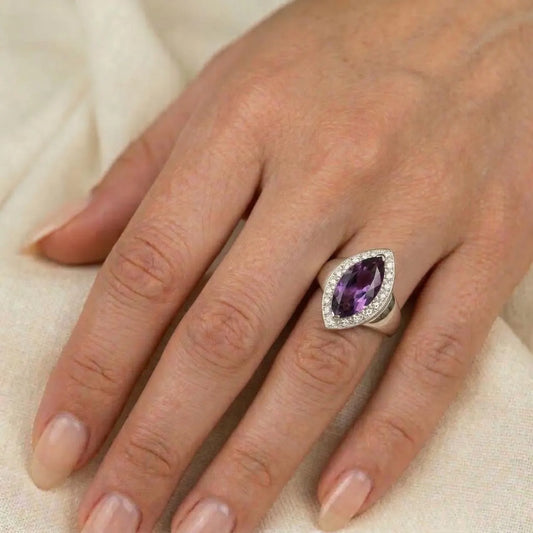
This honey opal is 925 sterling silver with an anti-tarnish treatment. The center is a marquise honey opal cabochon of about 3.2 carats, with two faceted citrines; the ring weighs about 2.9 grams. A cabochon is a smooth dome, not a faceted point. Opal is more water-sensitive than quartz; treat it as last-on, first-off jewelry even if the silver agrees with you.
Everyday habits that beat a marketing claim
Metal choice is half the story. The other half is what you leave under the band:
- Rinse and dry after a sweaty commute.
- Do not sleep in rings if you wake with a damp, indented finger.
- Keep lotions, sunscreen, and perfume off the inner shank until they have dried on skin.
- Do not use toothpaste, baking soda, or silver dip on a gold-plated ring; they can strip the plate you wanted as a barrier.
- Store pieces dry, not in a bathroom cup.
None of these metals change luck, mood, or health. Chemistry and contact time do the work. A 925 sterling ring with a documented 18k plate is a practical everyday answer for many people who react to unnamed fashion metal. If a specific ring bothers you, stop wearing it. Get a persistent rash assessed rather than shopping for a stronger adjective.
FAQ
What are the best hypoallergenic metals for rings if I have sensitive skin?
Start with named 925 sterling silver or 18k gold plated over sterling. Dermatology references also commonly mention titanium and high-karat yellow gold. The listing has to name the metal. The word “hypoallergenic” alone is not enough.
Is 925 sterling silver hypoallergenic?
Not automatically. 925 tells you silver fineness. Conventional sterling is usually silver plus copper. Many people wear it daily. It is not a guarantee, and the stamp does not prove every component is nickel-free.
Does 18k gold plating help sensitive skin?
It can, while intact, because skin meets gold instead of the alloy underneath. GemRings! plating is about 3 microns of 18k gold on 925 silver. Cheap gold plate over nickel alloy is a different, riskier product.
Why does a silver ring leave a green mark?
Often copper in the alloy reacting with sweat and salts. The stain usually washes off. Itching or blisters is not the same problem.
Should I see a doctor about a ring rash?
If a rash is persistent, spreading, blistered, or painful, remove the jewelry and seek medical advice. Patch testing can identify nickel or other contact allergies. Do not treat a blog as a diagnosis.