Solitaire Gemstone Rings for Everyday Wear: One Stone, Honest Listings
Share
A solitaire is a layout, not a mood: one center gem on a band that stays out of the way. If you want solitaire gemstone rings for everyday wear, count the stones on the spec sheet first. Shops stretch the word.
GemRings! rings are 925 sterling silver. Gold styles add an 18k gold plate about 3 microns thick over that silver core, unless a product page says otherwise. Stones are named on the listing. None of them is a mined diamond. None of them is a luck charm or a medical device.
What a solitaire actually is
The Natural Diamond Council’s definition is strict: a single center stone on a plain or barely decorated band—no side stones, no halo. The word comes from Latin solitarius, “alone.” GIA’s 4Cs education uses the same idea for jewelry: one gem, held so you can see it.
The picture most people still have is Tiffany’s 1886 six-prong mount, which lifted a diamond off the shank so light could enter. Prongs remain the default because they show more of the stone. A bezel—a metal rim around the girdle—hides a sliver of outline and protects the edge. GIA flags bezels for active wear: less snag, less exposed facet. Cathedral, tension, and east-west mounts are still solitaires if there is only one stone.
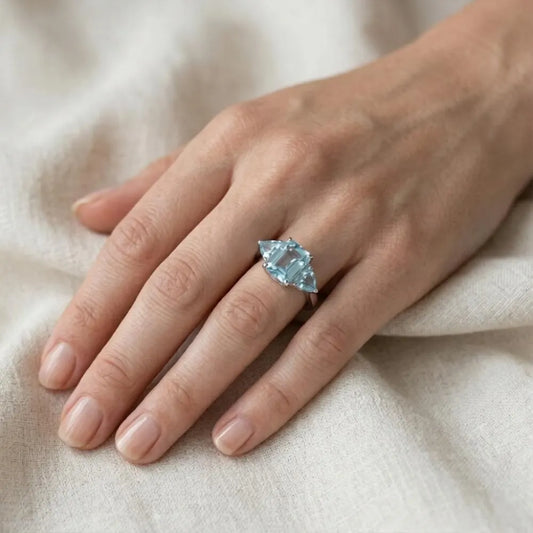
A halo gemstone ring is a different job. So is a three-stone, a toi et moi, or a pavé shank with a big center. Halos make the head look larger. Pavé loads the band with melee. Both collect lotion and lose small gems more easily than one well-set center.
Read the spec, not the nickname
In search results, “solitaire” often means “one obvious middle stone,” even when twenty cubic zirconia run down the shoulders. Treat the title as a hint. Treat the bullets as the contract.
- Material. 925 sterling silver, with or without an 18k gold plate of about 3 microns.
- Center stone. Species, cut, approximate carat weight. “Pink” is a color. Cubic zirconia is a diamond simulant. Synthetic sapphire is laboratory-grown corundum, not glass.
- Details. Extra stones listed here mean it is not a strict solitaire, even if the name says it is.
A true one-stone ring is easier to wash and easier to stack later. It also shows every window, inclusion, and fingerprint.
Which gemstones survive a weekday
GIA treats durability as hardness plus toughness plus stability—not Mohs alone, and Mohs is not a linear scale. Household dust is mostly quartz. Gems below 7 haze faster on a ring than on a pendant.
- Quartz (rock crystal, champagne quartz, lemon quartz, amethyst): Mohs 7. Hard enough for daily rings if you do not use the stone as a tool. Quartz has no cleavage, which is why rock crystal is a common colorless everyday option.
- Topaz: Mohs 8, so it resists scratches better than quartz. It also has cleavage; a sharp knock can split it. Prefer a lower head.
- Cubic zirconia: GIA lists CZ at about Mohs 8.5. It is hard and usually eye-clean. It is still a simulant, and GIA notes it can yellow with age.
Pearls and some opals elsewhere in the catalog are last-on, first-off. They are a poor match for a never-take-it-off brief.
This is a strict solitaire: 925 sterling silver, a natural champagne quartz, marquise-cut, about 1 carat, and no side-stone line. Weight is about 3 grams. Quartz at Mohs 7 handles weekday abrasion better than a pearl; the marquise points still want a snag-free seat. The page names champagne quartz from Brazil—not citrine unless a lab says so. Wear it alone, or stack it with a plain band. More cool-metal one-stone looks live in 925 sterling silver rings.
Silver or 18k gold plate is color, not a setting
Silver reads as a cool spotlight. The same layout in 18k gold plate reads warmer, closer to the engagement silhouette people already know. GemRings! gold plate is about 3 microns of 18k gold (75% gold) on a 925 core—a wearing surface, not solid gold. While intact you see gold. If it wears at the inner shank you see silver, not brass. Keep either metal out of pools and abrasive cleaners.
Gram weight is not the same as coverage. A 3-gram one-stone ring can feel wide if the shank is a dome. For how width changes the same EU number, use the ring size guide instead of copying a thin band’s size onto a bold shank.
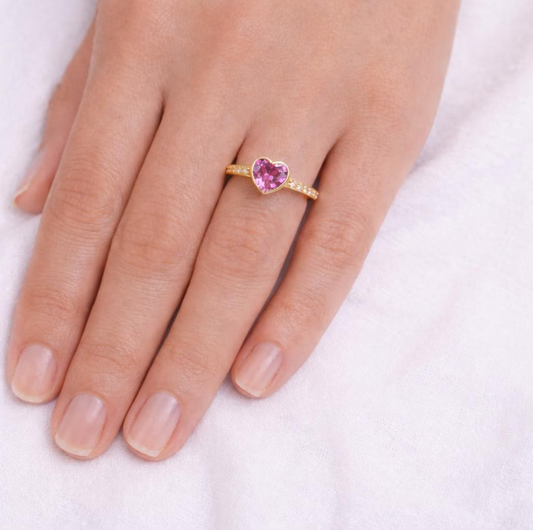
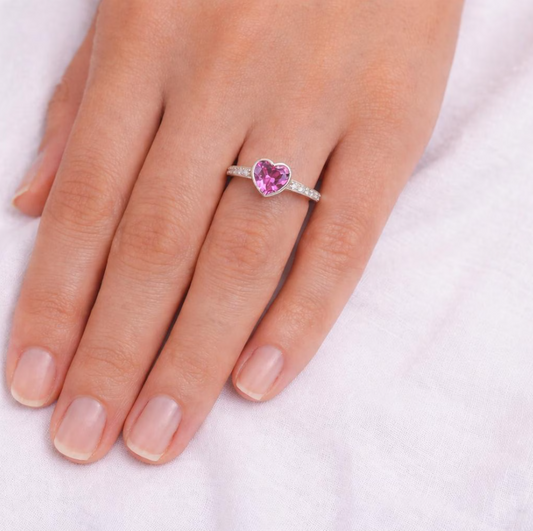
This heart is a true one-stone ring in gold color: 18k gold-plated 925 sterling silver, a 10×10 mm heart-cut lemon quartz of about 3 carats, a slightly domed band, about 3.1 grams. The page states the 3-micron 18k plate. Lemon quartz is quartz—Mohs 7—not yellow sapphire. No halo, no listed side stones. Everyday solitaire logic in a romantic outline.
How to choose solitaire gemstone rings for everyday wear
Use a checklist, not a mood board.
- Count the stones on the page. One center and a blank details line is a solitaire. One center plus “24 cubic zirconia” is a statement ring with a solitaire nickname.
- Match hardness to habits. Quartz and CZ can do commutes. Topaz can too if the head is not a snag tower.
- Watch height, not only width. Tall prongs catch knitwear. A low bezel or a stone set into a dome survives bags and keyboards better.
- Respect points. Marquise and heart tips chip first. Cushion and oval are more forgiving. A cocktail-scale oval still needs knuckle clearance.
- Size the shank you are buying. GemRings! lists EU 50, 52, and 54. A wide dome in 52 can feel tighter than a slim 52. Measure in the evening; between sizes, go up.
The name says solitaire. The spec says 925 sterling silver with an anti-tarnish treatment, an oval pink cubic zirconia of about 5.5 carats, and 24 smaller cubic zirconia; about 4.4 grams. That is a pavé-shoulder cocktail with a huge center. CZ is a diamond simulant; GIA notes it can yellow over years. Want a pink spotlight for evenings? This is the honest product. Want one stone you can wash without hunting missing melee? Use the champagne marquise or the lemon-quartz heart.
Care that is not a ritual
One stone hides less lotion. It is not indestructible. Last on after cream dries. First off before a gym, a pool, or detergent. Do not use toothpaste, baking soda, or silver dip on an 18k gold-plated shank—those can strip the plate. Store pieces apart so a harder stone does not frost a softer one. If a center wobbles, stop wearing it and see a jeweler.
A solitaire gemstone ring for everyday wear is a layout you can live in: one named stone, a named metal, and a head height that matches your week. Buy the spec sheet. Ignore the nickname if the nickname is lying.
FAQ
What makes a ring a solitaire?
One center gemstone, no halo, no side stones. Extra melee on the band is a different category, even if the title says solitaire.
Can I wear a solitaire gemstone ring every day?
Yes, if the stone is hard enough and the setting is low enough for your habits. Quartz (Mohs 7) and cubic zirconia (about 8.5) are common weekday choices. Remove any ring for heavy work, chlorine, and grit.
Are GemRings! solitaires diamonds?
No. Listings name the actual material—quartz, topaz, cubic zirconia, synthetic sapphire—set in 925 sterling silver or 18k gold-plated 925 sterling silver.
Solitaire or halo for everyday?
A solitaire is simpler to clean and has fewer small stones to loosen. A halo looks larger in photos and collects more cream.
Does gold plating change the setting?
No. Plating is color and a wearing surface. GemRings! gold plate is about 3 microns of 18k gold on silver, not solid gold.