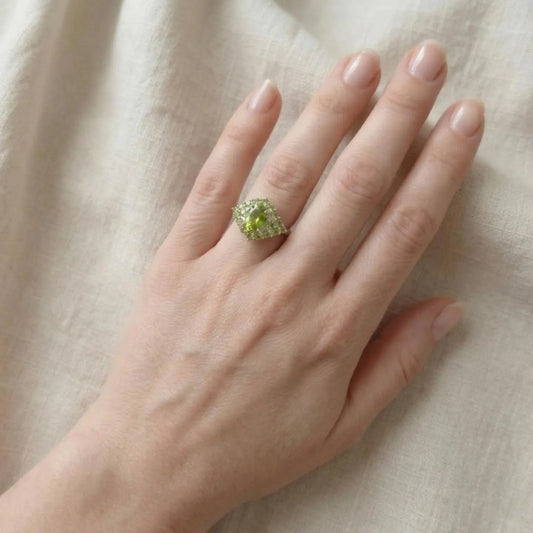
What Is a Godronné Ring? Fluted Gold-Plated Bands in Sterling Silver
Share
A fluted band is easy to notice and easy to misname. Listings say godron, godronné, reeded, or simply textured. If you have been asking what is a godronné ring, the short answer is this: the shank is shaped with a row of convex ridges that catch light as you turn your hand. GemRings! uses that band on two 18k gold-plated 925 sterling silver rings: an oval rose quartz and an oval sky blue topaz. The plate is about 3 microns. It is not solid gold.
What is a godronné ring, in plain terms
Godronné is the French goldsmith word. English silverwork usually says gadroon (sometimes godroon): an ornamental band of convex flutes, the kind of moulding you also see on old silver cups. On a ring those flutes run around the hoop. Each ridge is rounded, not a sharp V. The band looks thicker than a flat tube of the same weight because the high spots throw highlights and the grooves hold shadow.
It is a shank finish, not a stone cut. You can put any gem on a godronné hoop. The two styles here happen to use ovals. A smooth dome in the same shop is a different object: same gold-plated silver idea, no flutes. The ridges add grip, so the hoop spins less than a polished tube. They also create more surface area, which means more places for lotion to sit and more peaks for an 18k plate to thin. That last point matters more than the French name.
Gold plate on a reeded shank is a wearing budget
Both godronné rings start as 925 sterling silver. The gold color is an 18k layer about 3 microns thick. The product pages also call that stack vermeil. Shop the numbers: silver core, 18k on top, a published thickness. The hoop is not 18k gold all the way through.
The U.S. Federal Trade Commission jewelry guides treat “gold plated” as a surface. Ordinary gold electroplate is a minimum thickness equivalent to 0.175 microns of fine gold. Their “heavy gold electroplate” example is 2.5 microns of fine gold. A 3-micron 18k layer (18k is 75 percent gold) is a real everyday surface. It is still a surface. Keys, desks, and stacked rings hit the ridges first. When the plate thins you should see silver, not brass.
A fluted shank wears less evenly than a smooth one. The peaks take the knocks. The grooves stay gold longer and collect film. That is expected physics, not a defect you polish back into solid gold. A cloth will not put the gold back. Keep plated rings off chlorine and the gym; wipe them dry after a long day.
The two godronné rings in this catalog
Read the spec line the way you would read a materials label. Both styles are listed in EU 50, 52, and 54. On the ring size guide those insides are about 15.9 mm, 16.6 mm, and 17.2 mm across. Measure in the evening. If you sit between sizes on a reeded band, take the larger one. The ridges add a little bulk against the next finger.
Oval rose quartz on a fluted gold-plated band
The pink quartz godronné ring is 18k gold-plated 925 sterling silver. The center is one oval-cut rose quartz of about 2.4 carats. There are no side stones. Weight is about 3.6 grams. Rose quartz is pink quartz. The International Gem Society puts it at Mohs 7 with no cleavage, which is a decent weekday stone if you keep grit and steam away from it. It is not sapphire. The listing names rose quartz; it does not name a mine or a treatment. Do not invent either.
Pink next to gold plate is a quiet match. The oval does not sit as high as a 12 mm heart. The band already has rhythm, so a second busy ring beside it is noise. For more blush stones in the same metal family, browse the rose quartz rings lookbook.
Oval sky blue topaz with a cubic zirconia halo
The sky blue topaz godronné ring uses the same metal stack. The center is one oval-cut sky blue topaz of about 3 carats, with ten cubic zirconia stones around it. Weight is about 3 grams. Topaz is a different mineral from quartz. The Gemological Institute of America (GIA) rates it Mohs 8 and rates its toughness as poor because of basal cleavage. A hard knock on an edge, sudden heat, or a tight squeeze is how chips happen. GIA says skip ultrasonic and steam; use warm, soapy water.
Most jewelry-grade blue topaz starts as colorless material that is treated for color. This listing names sky blue topaz and does not specify a treatment. Do not upgrade it to “untreated” in your head. Cubic zirconia is a diamond simulant, typically around Mohs 8.5: fine as small sparkle, hard enough to mark a softer neighbor if two rings grind. Blue on gold plate is higher contrast than blush quartz. The halo adds a bright rim and more places for lotion, so dry the gallery after you wash your hands.
How a godronné ring actually wears
Give the fluted band its own finger. A second tall setting on the same digit will tilt and sand the ridges. A slim silver heart on the next finger is enough if you want company. Mix silver and gold-plated if you like contrast; repeat each metal once so the mix looks chosen.
Index and middle fingers give an oval of 2.4 to 3 carats room. The ring finger works if the neighbors stay empty. Make a fist. If a ridge catches the next finger before the hand closes, skip a same-finger stack. Weight is modest. You feel the texture more than the grams when you type. Take the ring off for gym plates, granite counters, and bleach. Household dust is mostly quartz. A Mohs 7 rose quartz can haze another Mohs 7 stone if they rattle in a dish. Topaz is harder; its cleavage is the real weekday risk, not scratches.
A useful low companion is a 1.6-gram dainty heart in 925 silver, set with cubic zirconia. Wear it on the next finger, not pressed against the flutes. Same-finger pairing with a reeded plated shank will scuff the gold line. Compare the two godronné heads in 18k gold-plated rings. Do not pair two godronné bands on one hand as twins. The ridges compete. One fluted hoop, one smooth neighbor, empty skin somewhere: that is the default.
Fit and care for a fluted plated band
Measure the finger you will wear, in the evening. A reeded band can feel tighter than a polished 52 of the same stamp because the outer metal occupies more space. If you are between 50 and 52, take 52.
Last on, first off. Lotion and perfume dry, then the ring goes on. It comes off before a pool or a sink of chlorine cleaner. Cleaning is a cloth first. The grooves hold soap film; that dull look is often dirt, not worn-through gold. If you need more, use lukewarm water and a drop of mild unscented soap. A very soft brush can follow the flutes. Rinse quickly. Dry fully, including the groove next to the stone. Skip toothpaste, baking-soda paste, silver dip, ultrasonic machines, and steam. Dip attacks plate. Steam and ultrasound are a poor idea for topaz, per GIA.
Store each ring in its own slot. A harder cubic zirconia halo will mark rose quartz if they knock together overnight. 925 silver can still tarnish where the plate is thin. Wipe the hoop. If the oval rocks in the setting, stop wearing it.
Is godronné the same as a textured or vintage band?
Not exactly. Texture is the broad word. Godronné names a specific convex flute, borrowed from silverwork. A sandblasted matte band is textured and not godronné. A 1940s “tank” ring often used gadrooning in solid gold. These two catalog rings use the pattern on plated sterling. The look rhymes. The metal stack does not.
Is a godronné ring solid gold?
Not these. The core is 925 sterling silver. The gold look is an 18k plate about 3 microns thick. That is a real gold layer. It is not a karat-gold hoop.
Will the ridges wear faster than a smooth band?
The high spots will. That is the trade-off for the light play. Wear the fluted ring as the only plated piece on that finger, keep it off chlorine, and wipe the grooves. The silver core remains when a peak shows through.
Rose quartz or sky blue topaz: which godronné to buy?
Buy the stone you want to see, then accept the band. Rose quartz is quieter, no halo, a little heavier, Mohs 7 with no cleavage. Sky blue topaz is brighter, has cubic zirconia around it, and needs more care around knocks because of cleavage. Neither stone is a diamond. Neither plate is solid gold.
If the fluted band is what you wanted, buy the spec, not the filter. Convex ridges, a named oval, a thin 18k plate on silver. Wear one godronné ring for a week before you add another textured piece. The shank is the whole argument. Let the flutes finish the sentence.