What Is Cubic Zirconia in Jewelry?
Share
Cubic zirconia is a laboratory-made crystal that looks bright in a product photo. It is not a diamond. If you have been asking what is cubic zirconia in jewelry, the short answer is this: zirconium dioxide grown in a lab, cut to sparkle, and sold as a diamond simulant. On GemRings! it shows up as heart-cut stones and one large pink oval, all set in 925 sterling silver. None of those listings is a mined diamond. None is glass. Cubic zirconia is allowed. Calling it a diamond is not.
What is cubic zirconia in jewelry, in plain terms
Gemologists use two different words for lookalikes. A synthetic gem is the same mineral grown in a lab. A simulant only looks like the target stone. The Gemological Institute of America (GIA) is blunt: diamond simulants do not share diamond’s chemistry, crystal structure, or optical numbers. Cubic zirconia is a simulant. Laboratory-grown diamond is still diamond. They are not cousins.
GIA dates commercial cubic zirconia to the late 1970s. Powdered zirconium oxide is heated until it melts. The melt cools so crystals can grow. Most of the result is colorless and eye-clean. It can also be grown in color. Pink cubic zirconia on this site is still CZ. It is not a pink diamond and it is not pink sapphire.
Hardness sits at about 8.5 on the Mohs scale. That is tougher than quartz (7) and well short of diamond (10). GIA’s practical note: CZ takes scratches and rounded facet edges faster than diamond, and it has slightly more fire with less brilliance. Some people like those broad color flashes. Some people read them as too much. Neither reaction is a defect. It is the material.
Colorless cubic zirconia may yellow with time. That is a GIA con, not a rumor. A film of lotion can mimic the same dull look, so clean first. Cubic zirconia is also not zircon. Natural zircon is a different mineral, softer and a poor everyday ring stone. If a tag says “zirconia” and the price is a silver-ring price, you are almost certainly looking at CZ.
Cubic zirconia vs diamond, sapphire, and glass
Four white-or-pink sparkles show up in search results. They do not wear the same.
- Diamond is carbon, Mohs 10. Brighter luster, less fire than CZ on GIA’s comparison, and it keeps facet edges longer. Nothing in this catalog is a diamond.
- Cubic zirconia is lab-grown zirconium dioxide, Mohs about 8.5. Usually eye-clean, a little fire-heavy. GIA lists warm soapy water as always safe. Ultrasonic and steam are listed as safe for the stone. The setting may not be.
- Synthetic sapphire is laboratory-grown corundum, Mohs 9, with excellent toughness and no cleavage. The pink heart sapphire listing names a synthetic pink sapphire of about 2 carats, with cubic zirconia only as the halo. That center is not CZ.
- Glass is cheaper and softer. It chips on a ring. CZ is not glass. If a listing will not name the species, walk away.
Carat is a weight, not a millimetre. CZ is denser than diamond, so the same carat number is a smaller stone. A 1.6-carat heart-cut CZ is not a 1.6-carat diamond on the finger. Read the millimetre line when the page gives one: 5×5 mm and 7×7 mm are useful. “1.6 carats” without a size is a number, not a look.
What the GemRings! cubic zirconia rings actually are
Three in-stock styles carry cubic zirconia as the main stone. All three are 925 sterling silver with an anti-tarnish treatment. All three list EU 50, 52, and 54. That is inner circumference in millimetres. Confirm it on the ring size guide in the evening, not from a cold morning measurement.
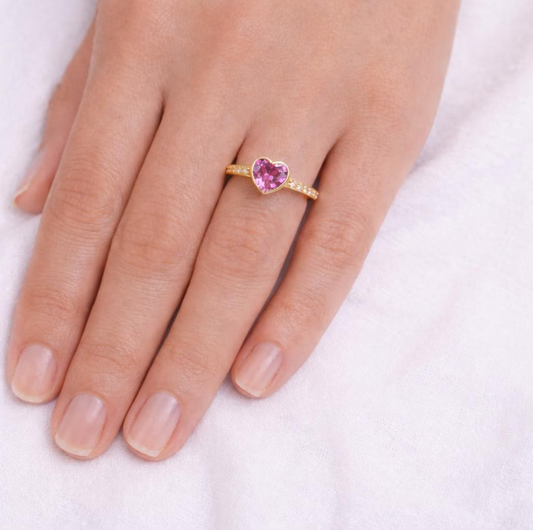
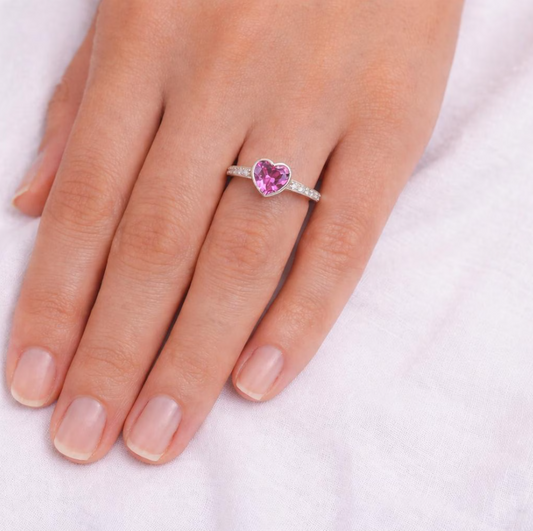
The smallest everyday heart is the dainty stacking ring. The center is a heart-cut cubic zirconia, 5×5 mm, about 0.8 carats, with 22 smaller cubic zirconia. The hoop weighs about 1.6 grams. At this scale the outline reads as a heart without covering the finger. It is the one you can type in. Wear it alone, or as the quiet second ring on the next finger. More cool-metal styles live in the 925 sterling silver rings collection.
The middle heart is the same idea, larger: heart-cut cubic zirconia, 7×7 mm, about 1.6 carats, with six smaller cubic zirconia. Weight is still about 1.6 grams. Two millimetres of extra face is the whole difference. It still stacks. It no longer hides. Give it its own digit if you already wear a wide cluster or a gold-plated dome. A 7 mm point can catch a knit cuff if the head sits high.
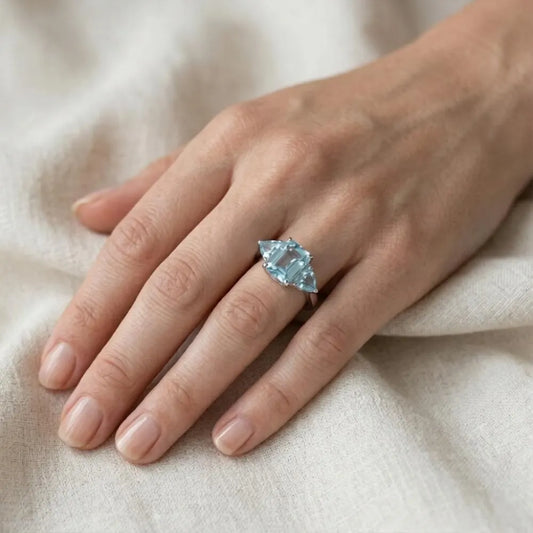
The loud CZ is not a heart. It is an oval pink cubic zirconia of about 5.5 carats, prong-set, with 24 smaller clear cubic zirconia on the band. The ring weighs about 4.4 grams. GIA notes that CZ can be grown in almost any color. Pink is a common tint. It is still a simulant, not rose quartz and not pink sapphire. Wear it as the only tall piece on that hand. A 4.4-gram pavé band feels tighter than a 1.6-gram stacker in the same EU size. If you sit between 50 and 52, take 52 on this one.
There is no 18k plate on these three. Gold-looking rings elsewhere in the shop are 18k gold-plated 925 sterling silver, about 3 microns, unless the product page says otherwise. That plate is not solid gold. Keep the metals straight when you mix a silver CZ heart with a gold-plated quartz heart.
How a CZ heart wears on a weekday
A 1.6-gram heart is a weekday ring if you treat the stone as a polished surface, not a tool. Lotion, soap, and sanitizer sit in the facet junctions and kill the sparkle first. That dull look is usually film, not a stone that “wore out in a week.”
Index, middle, and ring fingers all work for the 5 mm and 7 mm hearts. The pinky is tight for a 7 mm outline. Skip the thumb. The 5.5-carat pink oval wants the middle or ring finger and empty neighbors. Cubic zirconia is harder than quartz, opal, and pearl. A tight same-finger stack of CZ against rose quartz will haze the quartz first.
Mix silver and gold-plated if you like contrast. Repeat each metal once so the mix looks chosen. Keep one focal piece. A slim CZ heart plus a gold-plated lemon heart on the next finger is readable. A slim CZ heart plus the pink oval plus a cluster is a tray, not a hand. The heart tip is the weak geometry, not the Mohs number. If the point looks naked in the photo, it will snag.
Care that keeps cubic zirconia bright
Copy GIA’s home method: warm water, a drop of mild soap, a soft cloth or a very soft brush, rinse, dry. That restores most cloudy complaints. Skip toothpaste, baking-soda paste, and silver dip on a gemstone ring. Dip can strip an anti-tarnish finish and stain a gallery.
GIA lists ultrasonic and steam as safe for cubic zirconia itself. Skip them anyway if a prong looks open, if the ring mixes CZ with a softer stone, or if you are not sure. Vibration loosens small melee. The dainty heart has 22 extra stones.
Last on, first off. Perfume and lotion dry, then the ring goes on. It comes off before a pool, a bleach sink, or gym plates. Chlorine is unkind to sterling. Store each ring in its own pouch. Harder stones scratch CZ. CZ scratches quartz. For a longer silver note, see how to clean sterling silver rings.
If a colorless heart looks warm after a year, try the cloth. If the warmth stays in the stone, that is the yellowing GIA warns about. The ring is still wearable. Do not send it through a “diamond refill” kit. There is no diamond in it.
Is cubic zirconia a fake diamond?
It is a diamond simulant. That is a named substitute, not a counterfeit, when the listing says cubic zirconia. A fake diamond is CZ or glass sold as diamond. Read the species. Keep the word on the gift note.
Is cubic zirconia the same as synthetic sapphire?
No. Sapphire is corundum. CZ is zirconium dioxide. On this site the pink heart sapphire listing is synthetic corundum with CZ accents. The CZ heart listings are CZ all the way through. Hardness and fire are close enough to confuse a thumbnail. The spec line is not.
Does cubic zirconia get cloudy?
Usually film. Soap and skin oil sit in the facets. Clean with mild soap and dry it. Fine scratches accumulate because CZ is softer than diamond. Separate storage slows that. Yellowing of colorless CZ is a slower, separate change. A 5×5 mm heart is the easier daily piece in this catalog. A 5.5-carat pink oval is the louder one. Both are still simulants.
If the sparkle is what you wanted, buy the spec: cubic zirconia, millimetres, 925 silver, a heart or an oval you can actually live with. Wear the small one a week before you add the cocktail. One bright focal point is enough.