What Is Rock Crystal in Jewelry? Clear Quartz on a Gold-Plated Ring
Share
Rock crystal is a mineral name, not a type of table glass. If you have been asking what is rock crystal in jewelry, the short answer is this: it is colorless quartz. Silicon dioxide. No pink, no yellow, no dye in a normal listing. Light goes through it. GemRings! sets a faceted oval of it in a wide 18k gold-plated 925 silver dome. The gold layer is about 3 microns. It is not a diamond, and it is not solid gold.
What is rock crystal in jewelry, in plain terms
The Gemmological Association of Great Britain (Gem-A) calls rock crystal the purest variety of quartz: transparent and completely colorless. The International Gem Society says the same thing in buying language. Without trace impurities, quartz has no color. Jewelers kept the old name. The Greek word krustallos meant ice. People once thought the stone was water frozen so hard it would not melt. That story is history. The chemistry is SiO2.
Quartz is common. Gem-A notes it is among the most abundant minerals on Earth and grows as six-sided prisms. That abundance is why a 2-carat-class clear stone can sit on a weekday ring. Rarity is not the argument. Clarity and cut are.
Rock crystal is a variety of one species. Amethyst is purple quartz. Citrine is yellow quartz. Rose quartz is pink. Lemon quartz and champagne quartz in this catalog are still quartz. The clear one is the baseline.
It is not the “crystal” on a dining table. Glass is amorphous. Quartz is crystalline. The words sound related. The structures are not.
Rock crystal vs glass, cubic zirconia, and diamond
Three look-alikes show up in search results. They are different products.
Glass is softer on many recipes and holds heat differently. IGS notes that manufactured glass can show bubbles, flow lines, or an orange-peel surface. A jeweler with a loupe is looking for those, not for a story. Glass also has no true double refraction. Quartz does. You will not run that test at a kitchen table. You can still refuse a listing that says “crystal” and never names quartz or 925 silver.
Cubic zirconia is a laboratory stone. IGS classifies jewelry CZ as a created material, not a mined quartz. It is harder than quartz and usually throws more colored flash. That flash is why people use it as a diamond stand-in. Rock crystal does not. Gem-A is direct: rock crystal will not be as fiery as diamond because it does not disperse light to the same degree. Quartz dispersion sits around 0.013. Diamond is much higher. A well-cut rock crystal returns white light. It does not throw a rainbow the way CZ does.
Diamond is a different mineral (Mohs 10). This catalog does not sell diamonds. If a page says rock crystal, believe the mineral name. Do not upgrade it in your head.
“Herkimer diamond” is a nickname for rock crystal from Herkimer, New York. IGS calls it a misnomer. The GemRings! listing does not claim that locality, and you should not add one.
Household dust is mostly quartz. The Gemological Institute of America repeats this on its quartz care pages. A Mohs 7 stone can scratch another Mohs 7 stone. Rock crystal is weekday-tough and still not a workbench tool. Take it off for grit, gym plates, and granite counters.
What the GemRings! rock crystal ring actually is
Start with the listing, not the photo filter.
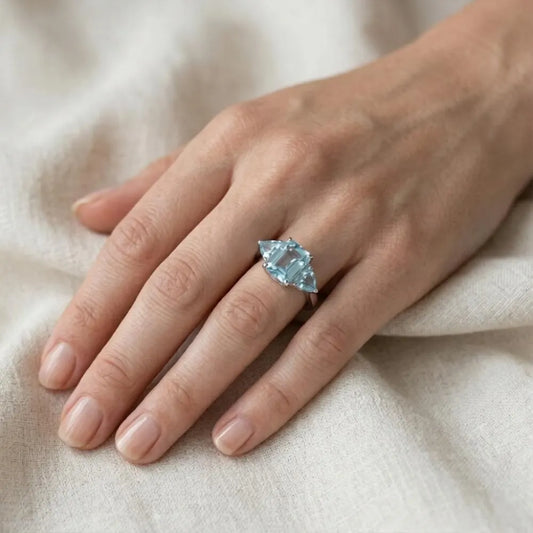
The bold dome gold-plated ring is 925 sterling silver with an 18k gold layer of about 3 microns. The center is an oval faceted rock crystal of about 2.4 carats. The band is wide. The ring weighs about 3 grams. Sizes are EU 50, 52, and 54. That range sits in the middle of the ring size guide (the full chart runs 48 to 54). A wide shank feels tighter than a slim heart of the same inner circumference. Measure in the evening. If you are between sizes, take the larger one on a dome.
The gold look is a plate, not a karat-gold hoop. Compare other warm-metal styles in 18k gold-plated rings. The plate can wear at edges if you grind it on a desk or against a harder stone. The core is still sterling.
The stone is faceted, not a cabochon. You should see a grid of small faces and a bright window when you tilt the hand. If the oval looks milky in every light, you are not looking at a clean rock crystal, or the photo is filtered.
Other quartz on the same hand
Color is optional. The species is not.
The champagne quartz marquise silver ring is 925 sterling silver, about 3 grams, with a natural Brazilian champagne quartz of about 1 carat. Same mineral family. Warm body color. A slim outline instead of a dome. It can sit on the next finger while the rock crystal takes the lead. Do not stack the two heads on one finger. The dome will tilt the marquise.
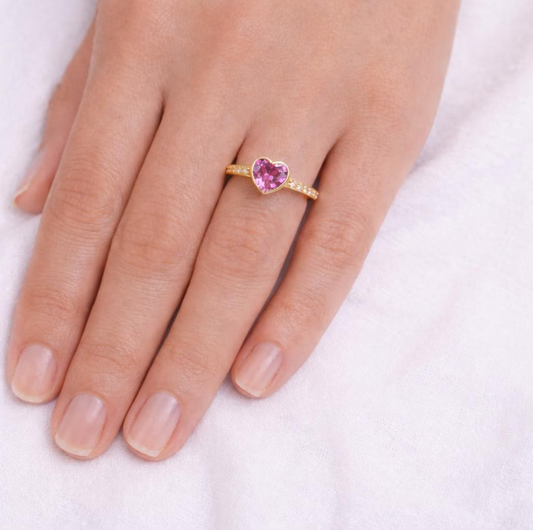
The lemon quartz heart gold-plated ring is 18k gold-plated 925 silver, a 10×10 mm heart of about 3 carats, a slightly domed band, about 3.1 grams. Yellow quartz, heart outline, same plate thickness as the dome. The listing does not name a treatment. Do not invent one. Some lemon quartz on the market is treated; this page is silent, so the useful facts are the species and the cut.
All three are quartz at Mohs 7. Care is the same for the stone. The metal finish is not: two are plated, one is bare silver. If you want the cool metal next to the dome, start from 925 sterling silver rings.
How a clear stone wears on a wide band
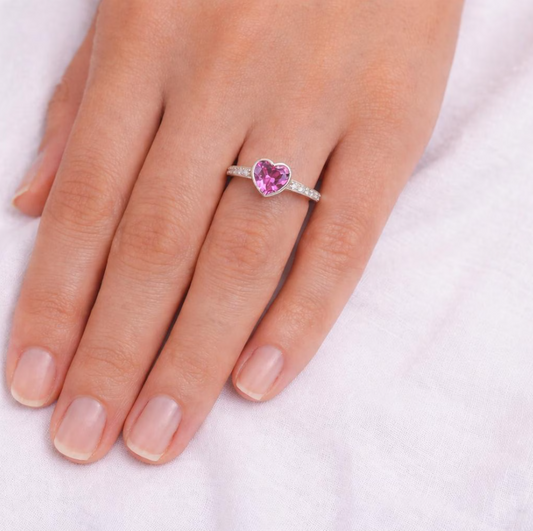
A colorless oval does not shout from across a table. That is the point. You see the architecture of the dome first, then the window of the stone. A pink heart or a cluster next to it will win the glance. Keep the dome as the focal piece on that hand, or accept that the colored stone is the lead.
Index and middle fingers give a wide band room. The ring finger works if you leave the neighbors empty. A second statement ring on the same finger is how the plate scuffs and the setting knocks.
Mix metals if you like contrast. Repeat each metal once so the gold plate does not look like a leftover. A silver champagne quartz on the other hand is enough.
Weight is modest: about 3 grams. The width is what you feel when you make a fist. If the dome hits the next finger before you close your hand, the stack is already too much.
Care for quartz and a thin gold layer
GIA’s quartz notes on citrine, amethyst, and rose quartz agree on the home method: warm, soapy water, a soft cloth or a soft brush, rinse, dry. Steam is not recommended. Sudden heat can shock quartz. Ultrasonic is often fine on untreated, unfilled quartz. Skip it if you are not sure the stone is untreated, and skip it on a plated ring you care about. Vibration can loosen a setting. The plate does not need a jewelry steamer.
Chlorine, bleach, and abrasive cleaners are unkind to gold plate and to silver. Off for the pool and the sink if you use harsh products. Lotion and perfume first, then the ring. Dry the gallery after you wash your hands. A film on a clear stone looks like a dull diamond. It is usually soap.
Store the dome in its own slot. Cubic zirconia and synthetic sapphire are harder. They will haze quartz if they rattle together. A silver dip is for tarnish on bare metal. It is a poor idea on an 18k plate.
925 silver still tarnishes where the plate is thin or worn. Wipe the hoop. If the oval rocks in the setting, stop wearing it. A smooth pavilion can slip more quietly than a stone with a thick girdle.
FAQ
Is rock crystal the same as crystal glass?
No. Rock crystal is crystalline quartz. Table “crystal” is glass, often leaded. The names overlap. The materials do not.
Is rock crystal a diamond alternative?
It is a clear stone. It is not a diamond. Lower hardness, lower fire, different chemistry. Gem-A notes it has been used as a diamond imitation for centuries. That is a look, not a substitute on a spec sheet.
Can you wear a rock crystal gold-plated ring every day?
Yes, if you treat the plate as a thin gold layer and the stone as quartz. Off for gym, grit, chlorine, and heavy housework. A wide dome wants its own finger.
If the clear oval is what you wanted, wear the dome for a week before you add a stack. The metal does the talking. The quartz keeps the window honest.