Are Gold-Plated Silver Rings Good Quality? How to Read the Specs
Share
The question is usually about a thin gold wash on brass. That ring looks warm in a photo and patchy after a month of dishes. A gold-plated silver ring is a different object. If you are asking whether gold-plated silver rings are good quality, the useful answer is a stack you can name: a 925 sterling silver core, an 18k gold plate, and a thickness in microns.
GemRings! gold styles use that stack. Several listings state a plate about 3 microns thick. That plate is not solid gold. It is also not the flash finish on a lot of costume jewelry. Quality here means honest metal, a published layer, and stones named as they are.
Are gold-plated silver rings good quality if the listing names the stack?
Yes, when three lines are on the page. The core is 925 sterling silver. The surface is 18k gold-plated, not only “gold color.” A thickness is given in microns. Stones have a species: quartz, topaz, cubic zirconia. No mystery “gem.”
No, when the shop will not say what sits under the gold. “Gold tone” and “gold look” describe a photograph. They do not describe a wearing surface. A brass ring with a whisper of gold is still gold-plated in the loose sense. It is not jewelry-grade plated silver.
Good quality also has a limit you should hear out loud. Plated gold is a color on another metal. It will thin where a ring rubs. That is expected wear, not a fake. If you want gold alloy through the shank, you are shopping solid karat gold and a different price.
What the labels are allowed to mean
Sterling silver is 92.5 percent silver. The rest is almost always copper, which hardens the shank so a setting can hold. Fine silver (999) dents. You do not want it as a daily hoop.
18k gold is 75 percent gold in the plate alloy. Karat describes that alloy. It does not describe how thick the layer is. A micron is one thousandth of a millimetre. Thickness is how much gold you have to wear through before the metal underneath shows.
U.S. Federal Trade Commission jewelry guides (16 CFR 23.3) set a low floor for “gold plated” or “gold electroplate”: at least 10k gold alloy, and a minimum equivalent to 0.175 microns of fine gold. The same guides reserve “heavy gold electroplate” for 2.5 microns of fine-gold equivalent. Both labels can be honest. They are not the same ring.
A 3-micron 18k plate on 925 silver sits in the thicker neighborhood. GemRings! still lists those rings as 18k gold-plated 925 sterling silver. That is the accurate shop label. Vermeil vs gold-plated sterling silver is a narrower U.S. guide term. This catalog does not sell rings as vermeil.
Four checks before you pay a jewelry price
Read the materials line the way you would read a food label. Four facts separate a weekday ring from a party favor.
- Core metal, named. 925 sterling silver. Not “alloy.” Not silence. If the gold wears, you should see silver, not yellow brass.
- Karat and microns, both. 18k without a thickness can still be a flash. A micron number without a karat can still be a pale alloy. Ask for both. If a GemRings! gold listing does not state 3 microns, do not invent the number.
- Wear color. High spots fail first: the inner shank, the underside of a dome, the place two rings sand each other. Silver showing through gold is the core doing what a silver core does. Brass showing through gold is a different product.
- Stones with a species. Lemon quartz is quartz. Rock crystal is colorless quartz. Cubic zirconia is a diamond simulant. Synthetic sapphire is lab corundum, not a mined stone. Named stones tell you how to clean the ring. Mystery stones do not.
Weight is comfort, not proof. A 3-gram plated band can be well made. A hollow fashion hoop that feels like foil is a different object even if the photo is warm.
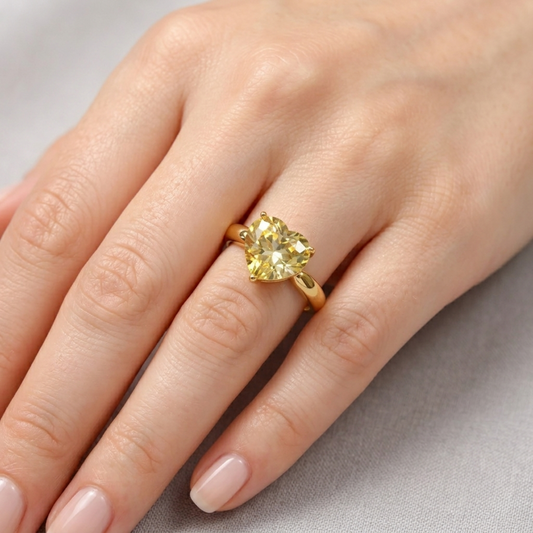
This ring is 18k gold-plated 925 sterling silver. The listing states a 3-micron plate. The centre is a heart-cut lemon quartz of about 10×10 mm, roughly 3 carats. The band is slightly domed. Weight is about 3.1 grams. Quartz sits around Mohs 7: ordinary scratches are fine; a knock can still chip it. Wear the heart alone on that finger. Take it off for bleach and the gym.
Where a good plated ring still wears
Rings are the hardest case for any surface finish. They tap keys, twist lids, and rest against other bands. Earrings mostly sit on fabric. A well-made plate still thins at contact points. That is physics, not a verdict on the 925 stamp.
A spinning hoop makes the problem faster. The inner shank rubs skin all day. GemRings! uses European millimetre sizes (ISO 8653). The number on the variant is the inner circumference. Most listings here are 50, 52, and 54. Measure in the evening. If you sit between sizes, the ring size guide says to take the larger one. A slightly loose plated ring can be stacked. A tight one that you fight on and off will scuff first.
Texture has the same logic. Ridges and flutes look considered. They also create high spots. Those high spots meet pockets and keyboards first. Leave a fluted or godronné shank alone on that finger if you want the gold color to last. A slim silver companion can live on the next finger.
This ring is 18k gold-plated 925 sterling silver. The listing states a 3-micron 18k plate. The centre is an oval-cut rock crystal of about 2.4 carats: colorless quartz, not glass and not diamond. The shank is a bold, smooth dome. Weight is about 3 grams. A wide gold surface marks on a desk long before a slim band does. Order the size that clears the knuckle. A dome that stops halfway down the finger is not breaking in.
Same silver quality, different color
The silver in a plated GemRings! ring is the same standard as the cool-metal collection: 925. Gold plate is a color choice on that core. It does not upgrade quartz to citrine or a simulant to a mined stone. It does not turn the shank into solid 18k.
Choose the finish that already matches the jewelry you wear. Browse 18k gold-plated rings if your everyday chain is warm. Stay with 925 sterling silver rings if you prefer a cooler metal and simpler care. Mixing metals is fine when you repeat each metal once so it looks chosen.
This ring is 18k gold-plated 925 sterling silver. The listing again states about 3 microns. The centre is a heart-cut mint green quartz of about 8×8 mm, roughly 1.5 carats, with two pear-shaped green quartz stones of about 0.7 carats each. Weight is about 2.2 grams. Three stones mean more prongs. Leave the next finger empty. The lighter shank uses the same metal stack as the heavier dome. Weight is not karat.
Habits that keep the quality you bought
A thick plate still wants last-on, first-off habits. Perfume and lotion go on first. The ring goes on when you leave. It comes off before a shower, a pool, bleach, or the gym.
Clean with a soft, dry cloth. If you need more, use lukewarm water and a drop of mild soap, then dry the underside. Skip toothpaste, baking-soda paste, silver dip, ultrasonic, and steam. A silver polishing cloth can take gold off. When a high-rub patch looks cooler, that is likely the silver core. A cloth will not put the gold back.
Are gold-plated silver rings good quality? They are when the shop writes the stack down and the plate is thick enough for a ring, not only for a photo. 925 silver, 18k gold, a few microns, a named stone. That is a weekday build. It is not an investment bar. If a listing fails those four checks, keep walking.
Are gold-plated silver rings fake gold?
The gold in the plate is real gold alloy. 18k means 75 percent gold in that layer. The shank underneath is 925 silver, not solid karat gold. “Fake” is the wrong word for a named plate. “Surface” is the accurate one.
Is 3-micron plating good quality for a ring?
It is a thick everyday plate compared with fashion flash, often well under 1 micron. U.S. guides treat 2.5 microns of fine-gold equivalent as the start of “heavy” electroplate. Rings still rub. Years of careful wear are realistic. Daily showers are not.
Do gold-plated silver rings turn your finger green?
A worn-through brass plate can mark skin for some people. A 925 core showing through gold is a color change on the metal. Neither reaction is a medical claim. If a piece irritates you, stop wearing it.
Is plated gold the same quality as vermeil?
Only if you compare specifications, not words. Vermeil is a U.S. label with a silver core, at least 10k gold, and at least 2.5 microns. A published 3-micron 18k plate on 925 silver is already a thick, named build. Shop the numbers.