How to Care for Gemstone Rings at Home: Quartz, Topaz, and Pearls
Share
A dull gem is often a film. Lotion, soap, and city air sit in the facets and on the nacre. How to care for gemstone rings is a species question, not a mood. Quartz and topaz can take a short wash in mild soap. A pearl wants a cloth. The 925 sterling silver around them wants to stay dry after either job.
GemRings! rings use 925 sterling silver. Gold-looking styles add an 18k gold plate about 3 microns thick over that silver core, unless a product page says otherwise. That plate is not solid gold. Stones are named on the listing. Cubic zirconia is a diamond simulant. None of these materials change luck, mood, or health.
How to care for gemstone rings: read the listing first
Start with the materials line. If it says 925, the hoop is sterling silver: at least 92.5 percent silver under the U.S. Federal Trade Commission jewelry guides. The rest is usually copper, which is why the metal darkens around sulfur, sweat, and salt. If it says 18k gold-plated, you have a finite gold layer on that same silver. A dip that is fine on a plain band can strip the plate.
Then read the stone. Quartz, amethyst, citrine, and rock crystal are one family. Topaz is harder to scratch and easier to split. Pearl and opal are the gentle cases. Match the wash to the weakest part: a topaz halo around a pearl is a pearl ring.
Quartz, amethyst, and rose quartz
The Gemological Institute of America lists amethyst as quartz with a Mohs hardness of 7. Rose quartz, lemon quartz, mint green quartz, and rock crystal sit in the same family. Hardness 7 resists everyday scratches better than a pearl. It is not a license to knock the ring on a sink.
Warm water, a drop of mild dish soap, and a soft toothbrush reserved for jewelry will lift film from facets. Rinse. Dry with a lint-free cloth. Work over a closed drain. Quartz can take this bath. The silver still tarnishes if you leave it wet.
GIA notes that amethyst, citrine, and some other gems can fade with prolonged light. Do not park a purple or yellow quartz ring on a sunny windowsill. If the band is 18k gold-plated, skip silver dip, toothpaste, and baking soda. Those methods cut tarnish and gold. A short soap wash, rinsed and dried, is the limit at home.
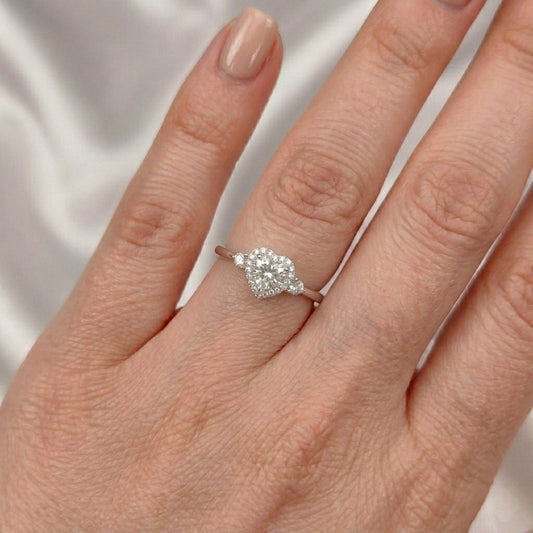
This heart is 18k gold-plated 925 sterling silver. The center is a heart-cut rose quartz about 12×12 mm (roughly 3 carats). Floral engraving runs along the band; the piece weighs about 3 grams. The quartz can take mild soap. The 3-micron plate cannot take a dip or a hard rub.
Topaz: hard to scratch, easy to shock
GIA ranks topaz 8 on the Mohs scale. That number is scratch resistance. Toughness is a different score. Topaz has basal cleavage: a sharp blow, extreme pressure, or a sudden temperature change can split it. That is why GIA tells you to skip steam and ultrasonic machines. Warm, soapy water is the method they call safe.
Do not move a topaz ring from a hot car to a cold tap. Do not knock a large oval against a ceramic mug. Heat shock is still a risk even for sky blue topaz. Chemicals affect the stone only slightly. Chlorine is still a problem for the silver around it. A halo of smaller Swiss blue stones needs the same gentle brush as the center, then a rinse, not an overnight soak.
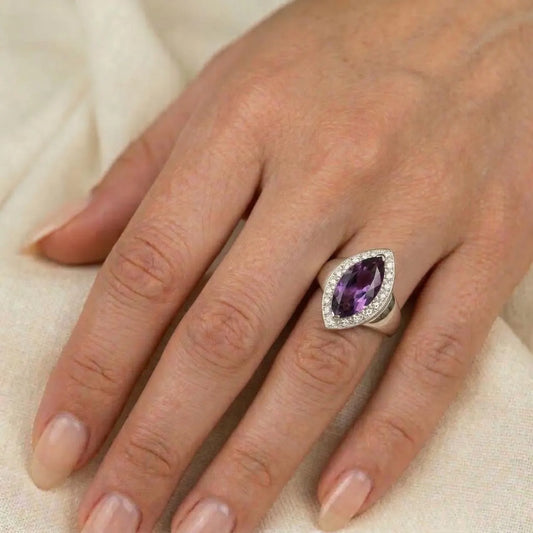
This halo is 925 sterling silver with an anti-tarnish treatment. The center is a natural oval sky blue topaz of about 3 carats, framed by 20 light Swiss blue topaz accents; it weighs about 3.3 grams. The finish slows sulfur on the metal. It does not make an ultrasonic machine safe for the topaz. Soap, rinse, dry. Browse more 925 sterling silver rings if you want a cool-metal band you can wash with the stone.
Pearls and opals: last on, first off
GIA’s pearl care note is short. Avoid perfume, hairspray, and cleaning agents. Keep pearls off sharp objects. Wipe after wear. Store in a soft pouch, not a dry hot cupboard. A freshwater pearl grew in water; pool chlorine is not that water.
Last on, first off is the habit. Lotion and scent dry first. The ring goes on when you leave and comes off before dishes, the gym, or a shower. Do not soak it, dip it, or put it in an ultrasonic cleaner. GIA lists organic gems among the stones those machines can damage. A barely damp soft cloth, then a dry one, is the home method.
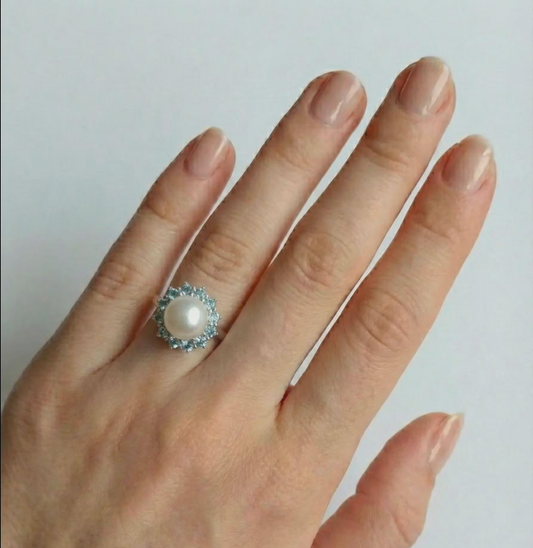
This halo pairs a button freshwater pearl of about 4.7 carats with 24 light Swiss blue topaz stones on 925 silver and weighs about 4.5 grams. The topaz can take soap. The pearl cannot. Treat the whole ring as a pearl.
Opal is another soft case. GIA treats it as fragile and bars ultrasonic cleaning. A cabochon can chip on a counter. Do not soak an opal to “feed” it; mineral oil only masks existing cracks. Wipe, dry, and keep it away from harder stones.
Cubic zirconia takes the same mild soap bath as quartz. Toothpaste is still a no: it can haze a polish and rough a plate. The catalog’s pink heart sapphire is synthetic corundum, laboratory-grown, not glass. It is very hard; the 925 band is not chlorine-proof. If a listing says dyed, as with the lavender jadeite cabochon, stay with a damp cloth.
The metal is half the job
Copper in 925 is why sterling darkens. An anti-tarnish treatment on many GemRings! silver rings slows that film. It does not make the ring pool-safe. For a longer note on sulfur and cloths, see how to prevent sterling silver rings tarnish.
A gold-plated band is 18k gold (75 percent gold) about 3 microns thick on that same silver. Three microns is a decent everyday thickness. It is still a coating. Heat, bleach, and a hard rub take gold off the high spots first. For plated pieces, a damp cloth is safer than a polish cloth with compound. Browse 18k gold-plated rings when you want warm color and are willing to skip dips.
Store pieces separately so a harder gem does not scratch a softer one. A lined box is enough. EU sizes here are usually 50, 52, and 54: inner circumference in millimetres. A tight ring forced over a wet knuckle is how a prong catches.
A weekday routine that is enough
Morning: last on. Skin products first.
Evening: first off. Soft cloth. Look at prongs and at any pearl or cabochon.
Once a week, if the stones are quartz, topaz, cubic zirconia, or sapphire: closed drain, mild soap, soft brush, rinse, dry.
Pearls and opals: cloth only, every wear.
Never: bleach, ammonia, toothpaste, ultrasonic machines, steam, the pool, the ocean, a hot tub.
If a stone rattles or a prong looks bent, stop wearing it. A loose gem is a loss, not a style choice.
FAQ
Can I use a jewelry cleaning machine at home?
Not as a default on this catalog. GIA warns against ultrasonic and steam for topaz, pearls, opals, and many treated gems. Warm soapy water or a cloth covers the stones we sell.
How often should I wash a quartz or topaz ring?
When it looks filmed, or about once a week if you wear it daily. Dry it every time.
Is sterling silver with a gemstone hypoallergenic?
925 is a purity stamp, not a medical claim. If your skin reacts, take the ring off. We do not sell rings as treatment.
Will gold plating survive a weekly soap wash?
A short wash, rinsed and dried, is kinder than a sink of dishes. The plate is not waterproof and it is not solid gold.
What if the ring already went in the pool?
Rinse in fresh water, dry completely, and inspect the stone and the inner shank. Do not reach for dip or a machine. Pitting or patchy gold is wear, not dirt a cloth will erase.
A named stone on named metal is easy to look after if you keep the method small. Soap for the hard gems. A cloth for pearl and opal. Dry 925 every time. That is the whole system.