How to Prevent Sterling Silver Rings Tarnish at Home
Share
Tarnish is chemistry, not a verdict on the stamp. If you want to know how to prevent sterling silver rings tarnish, skip the weekly “rescue polish.” Slow the film with a wipe after wear, dry storage, and cleaners that match the stones. You will not stop sulfide forever. You can keep it from turning a weekday ring grey in a month.
GemRings! silver styles are 925 sterling silver. Many listings add an anti-tarnish treatment. Gold-looking styles are 18k gold-plated over that same silver core, about 3 microns thick unless a product page says otherwise. That plate is not solid gold. Stones are named on the listing. Do not upgrade them in your head, and do not clean them as if they were bare flatware.
How to prevent sterling silver rings tarnish on a weekday
Put the ring on last. Take it off first. Perfume, hairspray, lotion, and sanitizer sit on metal and in galleries. Jewelers Mutual’s silver-care notes put makeup and chlorine in the same “not while wearing” list as swimming. That is not fussiness. Sulfur compounds and salt speed the film.
Then wipe. A soft, dry, lint-free cloth after you take the ring off removes sweat and soap before they dry in place. Winterthur’s silver conservators note that dust holds moisture against the surface and makes tarnish faster. A commute film is the same idea at finger scale.
Keep a tight band from becoming a wet cuff. A spinning or pinching shank traps perspiration against 925 metal. GemRings! uses European millimetre sizes (ISO 8653). If you sit between two listed sizes, the ring size guide says to take the larger one. A looser 52 that dries is kinder to silver than a proud 50 you never take off to wash dishes.
Last, put it away dry. Not next to the tap. Not in a gym bag. The long version of boxes, pouches, and anti-tarnish strips is in how to store rings to prevent tarnish. This page is the wear-and-wipe half of the same job.
What the dull film actually is
Sterling is 92.5 percent silver. The rest is almost always copper, which hardens the shank so prongs can hold. The Canadian Conservation Institute describes tarnish as a surface reaction: silver meets sulfur gases, especially hydrogen sulfide, and forms silver sulfide. On sterling, copper sulfide joins the film. The metal looks yellow, then brown, then grey-black. Copper also makes sterling tarnish faster than fine silver.
Humidity helps. Winterthur recommends keeping stored silver under about 50 percent relative humidity when you can. A bathroom cabinet fails that test. Rubber bands, latex, wool, and some papers off-gas sulfur. Chlorine and bleach accelerate the film. A green smear under a tight band is a different copper reaction with sweat and soap. Both are chemistry. Neither means the 925 mark is fake.
An anti-tarnish treatment is a head start
Several GemRings! silver listings name an anti-tarnish treatment on the 925. That is a factory finish. It slows the first weeks of wear. It is not a license to leave the ring in steam or a chlorinated pool. Once the finish wears at high spots, the alloy behaves like ordinary sterling. Light friction from skin can wipe early sulfide before it darkens, which is why worn pieces often stay brighter than rings left open to air. That is true for solid sterling, not a reason to grind an 18k gold-plated ring against keys. Plate is a wearing surface, not a polish budget.
This ring is 925 sterling silver with an anti-tarnish treatment. The centre is a 5×5 mm heart-cut cubic zirconia of about 0.8 carats, with 22 smaller cubic zirconia stones. Weight is about 1.6 grams. Cubic zirconia is a diamond simulant, not a diamond. A light stacker still holds lotion in the tiny settings. Wipe the gallery after you wash your hands. More cool-metal pieces live in 925 sterling silver rings.
Keep polish off the stones
Prevention is a cloth. Removal is a different tool. Winterthur is blunt: any abrasive polish removes a little silver. Commercial dips dissolve tarnish and underlying metal, and they are a poor match for gemstone galleries. Jewelers Mutual flags silver cleaner on gem-set jewelry. Toothpaste and baking soda paste are still abrasives. The foil-and-soda bath is a trick for plain silver. Skip it on pearls, opals, dyed stones, and gold plate.
The safe home wash for a named-stone 925 ring is warm water, a drop of mild dish soap, and a very soft brush if the stones allow it. Rinse. Dry the underside. Polish residue in a halo traps moisture and makes the next film faster. Skip ultrasonic and steam unless you know the stone. GIA warns that pearl must not go in an ultrasonic, and that opal and topaz are a poor match for heat. Vibration can loosen a cluster. If a stone rattles, stop washing it at home.
This ring is 925 sterling silver with an anti-tarnish treatment. The centre is a natural emerald-cut amethyst of about 3.2 carats, with 20 smaller natural amethysts in the halo. Weight is about 5.4 grams. Amethyst is purple quartz, Mohs 7, with good toughness for weekday wear. Household dust is mostly quartz, so facets haze. Soap film in a halo looks like “dead metal” before the shank is truly black. Warm, soapy water and a dry cloth are the maintenance. Steam is not the shortcut.
Pearls and gold plate are separate jobs
A pearl does not want a silver dip or a rouge cloth. GIA ranks pearl at 2.5 on the Mohs scale. Heat can dehydrate nacre. Hair spray, perfume, cosmetics, and acid perspiration attack the surface. Put perfume on first. Wipe the pearl with a very soft cloth after wear. Occasional warm, soapy water is acceptable. No ultrasonic. No steam. Store it in a breathable pouch, not under a harder stone.
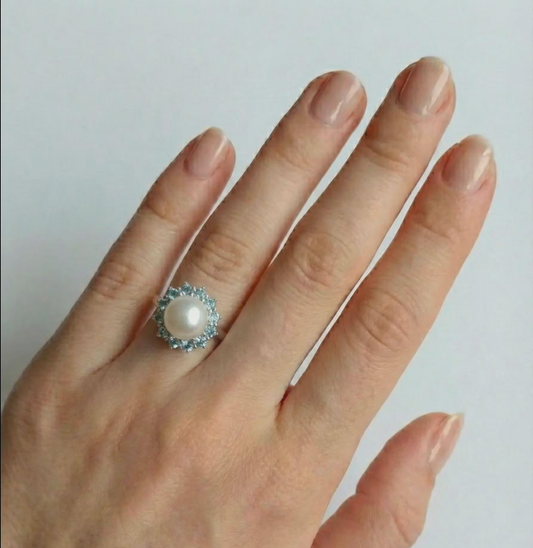
This ring is 925 sterling silver with an anti-tarnish treatment. The centre is a freshwater button pearl of about 4.7 carats, with 24 light Swiss blue topaz stones. Weight is about 4.5 grams. The pearl is the care problem. Topaz is harder (Mohs 8) and has cleavage; GIA treats it as a poor ultrasonic candidate. Wipe nacre. Dry the silver. Do not dip the whole head to “save” a dull shank.
Gold-plated rings are 18k gold over 925, about 3 microns on GemRings! listings that state a thickness. While the plate is intact you see gold, not silver sulfide. A silver polishing cloth is mildly abrasive. It can thin that plate. So can dip. If you want gold color, keep chlorine off it and stop other rings from sanding the inner shank. When the plate wears, you should see silver, not brass. A cloth will not put the gold back.
A sequence you will actually keep
One cloth by the door is enough. Wipe the ring when it comes off. If it still feels filmed, use warm water and a drop of mild soap, then dry the gallery. If a grey bloom is only on bare silver, use a jewelry silver cloth on the metal, not on the stones. Stop before you chase every crevice white. Over-polishing removes silver.
Between wears, give each ring its own pouch. If a piece will sit for weeks, press extra air out of a polyethylene zip bag and add a commercial anti-tarnish strip in the box, not stuck to a gem. CCI prefers polyethylene over PVC. Keep silica gel off pearls and opals. Take silver off for bleach, the pool, the gym, and a sink full of pans. Put it back on after your hands are dry.
What this will not do
It will not turn 925 into fine silver or solid 18k gold. It will not stop tarnish in a humid or high-sulfur room. Sterling still darkens. Plate still rubs. Pearl nacre still marks. Quartz still takes a haze from grit. Treat the metal as an alloy with a known reaction, not as a failure of the stamp.
Does sterling silver always tarnish?
Yes, given sulfur gases, humidity, and time. An anti-tarnish treatment and dry storage slow it. They do not cancel the alloy.
Is a black film a fake 925 mark?
No. Silver sulfide and copper sulfide are expected on sterling. Tarnish is not proof the stamp is fake.
Can I use toothpaste or baking soda on a gemstone ring?
No. Both are abrasives. Use mild soap and water, and a silver cloth only on bare metal if you need it.
Should I dip a GemRings! ring?
Do not. Dips are harsh on settings, pearls, and gold plate. A cloth and a soap rinse are the home tools.